


Brand: TASCAM
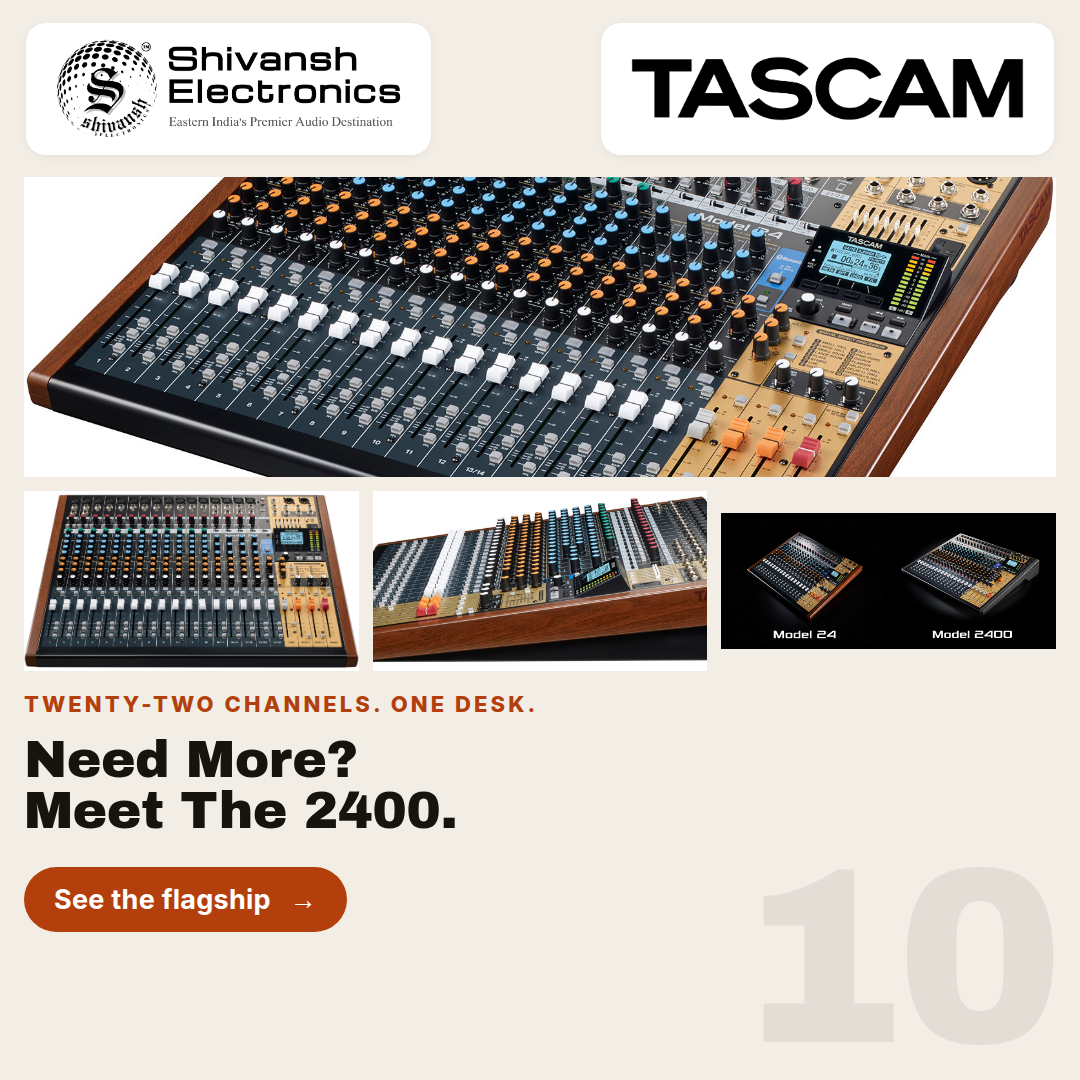
TASCAM MODEL 2400
Category: Recording Mixers
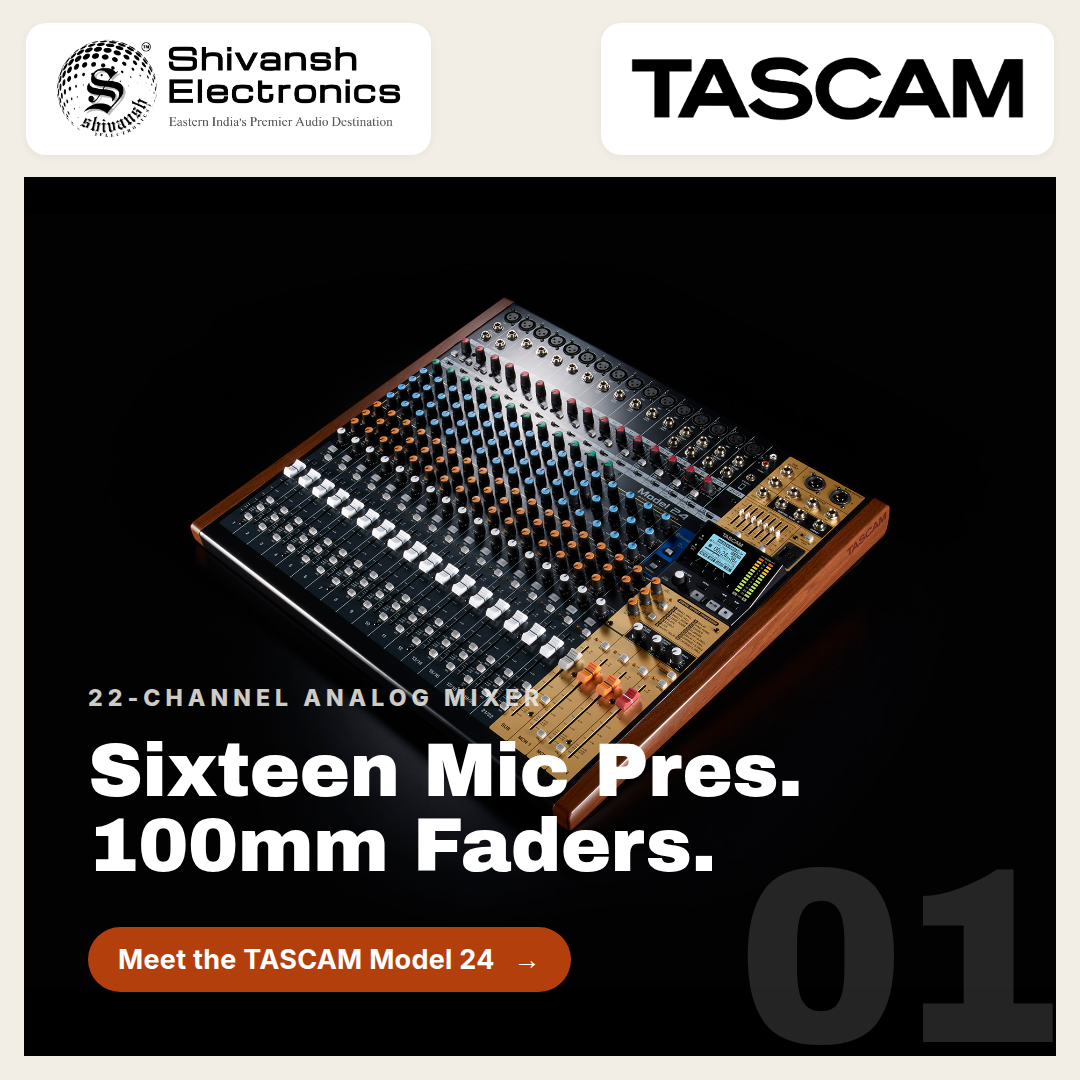
22-channel, 24-track analog console with Ultra-HDDA preamps and 24x22 USB interface — built for studio recording and live mixing alike.
PLEASE NOTE: Kindly contact us at +91 98316 62458 / +91 91477 00677 to confirm current availability and the best possible pricing (including any additional discount we may be able to offer) before making any payment.

GENERAL / FORM FACTOR
| SPECIFICATION | DETAILS |
|---|---|
| Product name | TASCAM Model 2400 |
| Manufacturer | TASCAM (TEAC Corporation) |
| Product type | Large-format flagship analog console mixer |
| Series position | Flagship of the Model series — shares the 24-track / 22-channel base of the Model 24, with HUI/MCU DAW control reinstated |
| Dimensions (W × H × D) | 680.5 × 132.5 × 568.0 mm |
| Weight | 14.0 kg |
CHANNEL COUNT & I/O
| SPECIFICATION | DETAILS |
|---|---|
| Total analog inputs | 22 analog inputs |
| Mic inputs | 16 XLR (Ultra HDDA) with +48V phantom power |
| Insert points | Channels 1 through 12 (1/4-inch TRS send/return) |
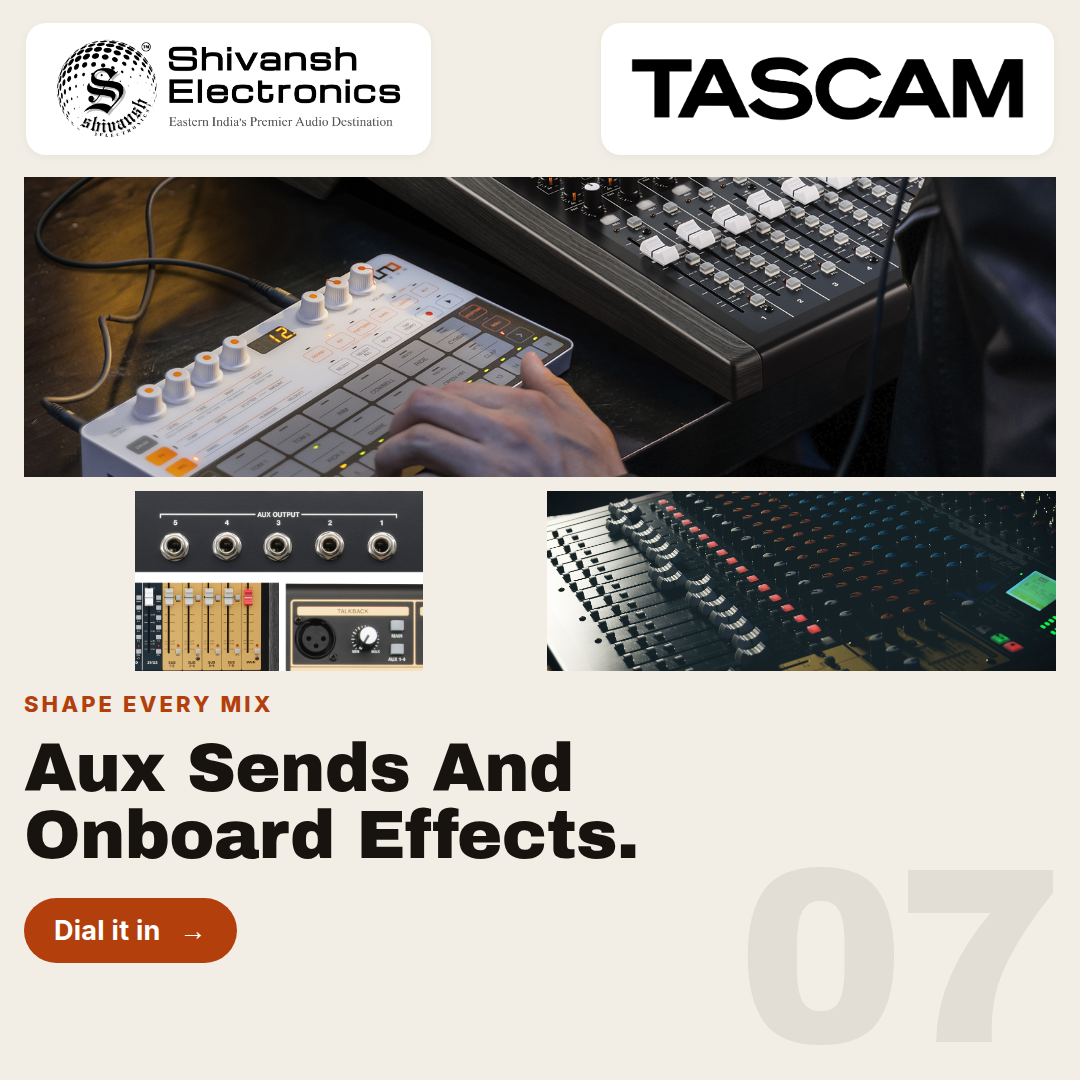
| Bus architecture | 5 Aux sends (4 discrete analog auxiliary buses + 1 internal FX send), 4 stereo subgroups, Main L/R |
| Auxiliary / communication inputs | Bluetooth (AAC/SBC), Talkback XLR input |
| MIDI | MIDI In/Out for sync and control, 1/4-inch audio click output |
PREAMP SPECIFICATIONS
| SPECIFICATION | DETAILS |
|---|---|
| Preamp type | TASCAM Ultra HDDA (High Definition Discrete Architecture) |
| Maximum gain | 74 dB (MIC to MAIN OUT) |
| Nominal input level | -8 dBu (at LEVEL "MIN") |
| Equivalent Input Noise (EIN) | -128 dBu (Rs: 150 Ω, Max Gain, A-weighted) |
| Input impedance | 22 kΩ (mono), 11 kΩ (stereo) |
CONVERTER SPECIFICATIONS
| SPECIFICATION | DETAILS |
|---|---|
| Sampling rate | 44.1 kHz / 48 kHz |
| Bit depth | 24-bit |
| THD | 0.003% (MIC IN to MAIN OUT, +2 dBu, 1 kHz) |
| Crosstalk | -80 dB (1 kHz, BPF) |
| Frequency response | 20 Hz – 30 kHz (+0.5/-1.0 dB, analog routing) |
RECORDING SPECIFICATIONS
| SPECIFICATION | DETAILS |
|---|---|
| Media supported | SDXC (supports punch in/out) |
| Simultaneous record | 24 tracks (22 channel inputs + 2 stereo mix) |
DIGITAL AUDIO TRANSPORT & DAW CONTROL
| SPECIFICATION | DETAILS |
|---|---|
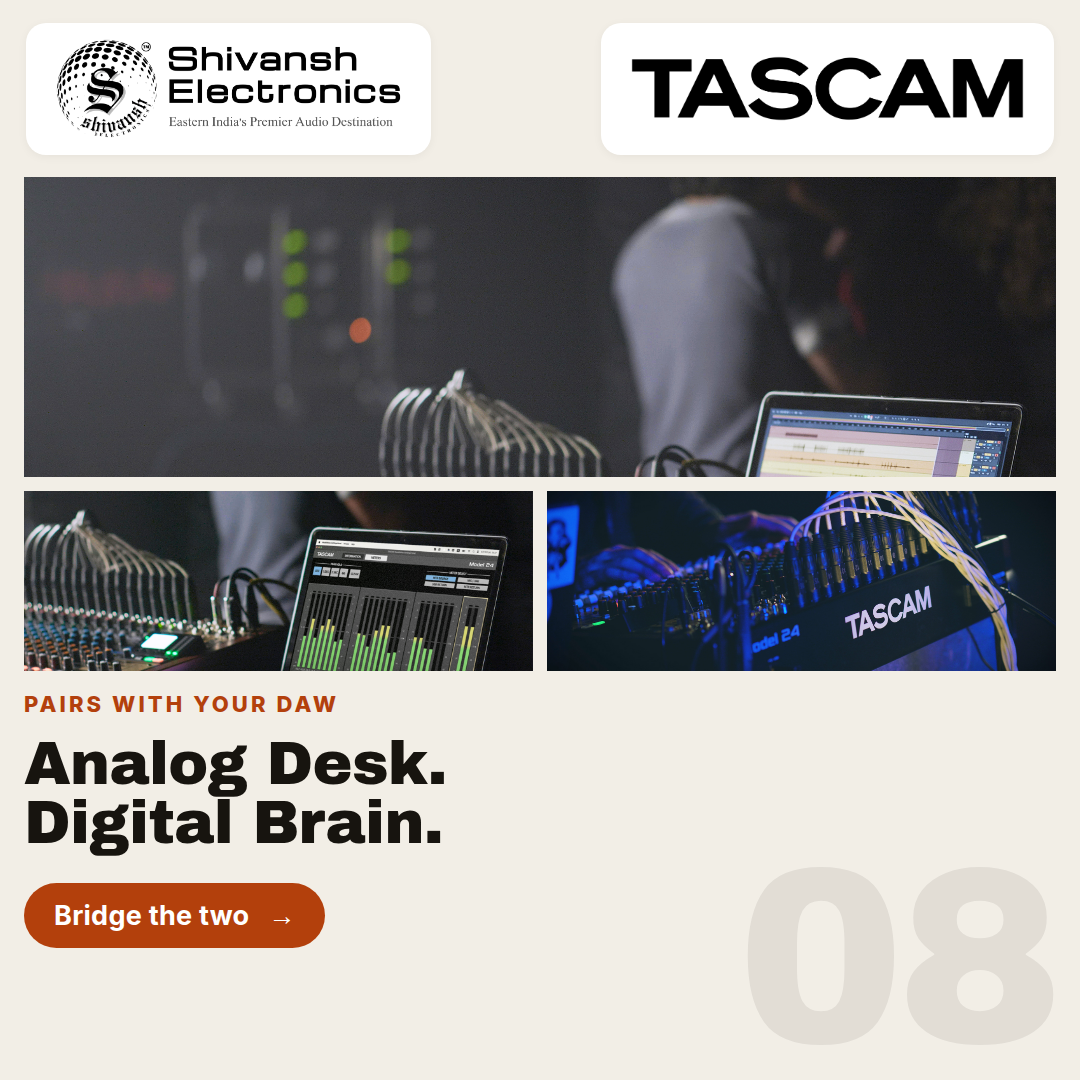
| USB interface | 24-in / 22-out USB audio interface |
| DAW control | Dedicated HUI/MCU transport and REC READY control |
| EQ routing (MTR return path) | Selectable pre/post EQ routing for both USB and MTR recording streams |
| Bypass functions | Compressor and EQ bypass available on multitrack return paths |
MONITORING & COMMUNICATION
| SPECIFICATION | DETAILS |
|---|---|
| Control room outputs | Dedicated control room output pair |
| Headphone outputs | Dual headphone jacks |
| Talkback | Built-in talkback XLR input |
| Wireless audio | Bluetooth (AAC/SBC codec support) |
1. PRODUCT OVERVIEW
The TASCAM Model 2400 is the flagship console of TASCAM's Model series, combining a 22-channel analogue mixer, a 24-track internal digital multitrack recorder, and a 24-in/22-out USB audio interface into TASCAM's largest and most professionally equipped hybrid analogue-digital production system. While it shares the 24-track recording ceiling and 22-channel analogue mixing layout of the Model 24 directly beneath it, the Model 2400 introduces a set of professional-grade enhancements that reclassify it from a live-sound and tracking tool into a dedicated commercial studio console — most notably reinstating the HUI/MCU DAW transport and recording control that the Model 24 omits, effectively merging massive analogue I/O capacity with deep digital DAW integration in a single chassis.
The Model 2400 occupies the top of the entire TASCAM Model family. Where the Model 24 is built around raw channel count and a classic tactile large-format mixing experience for live sound and tracking, the Model 2400 adds the studio-specific infrastructure that a live console does not need: a fifth aux send, four stereo subgroups for parallel bus processing, insert points across the first twelve channels rather than just the first two, dedicated talkback communication, MIDI synchronisation with a click output for drummers, and — critically — HUI/MCU protocol emulation that turns the console's physical faders into a tactile control surface for any HUI- or MCU-compatible DAW. This combination of channel capacity, documented audiophile-grade preamp performance, and DAW integration is what separates a genuine commercial studio centrepiece from a large-format live-sound desk.
Three figures anchor the Model 2400's technical position. First, its preamplification: 16 TASCAM Ultra HDDA microphone preamps deliver a rigorously documented 74 dB of maximum gain (mic to main out) with an Equivalent Input Noise (EIN) of -128 dBu — figures that rival dedicated standalone boutique microphone preamplifier units, confirming the console's studio-grade front end. Second, its routing depth: insert points span the first twelve channels (rather than the first two, as on the Model 24), five aux sends (four discrete analogue buses plus an internal FX send) provide genuinely independent monitor and effects routing, and four stereo subgroups allow entire instrument sections to be bused together for parallel analogue processing before reaching the main mix. Third, its DAW integration: dedicated HUI/MCU transport and REC READY control means an engineer can arm tracks, trigger playback, and control recording entirely from the console surface, without touching a computer mouse — restoring the tactile DAW-control workflow found on the entry-level Model 12 to TASCAM's largest-format console.
The Model 2400 is positioned explicitly for commercial recording studios, mix engineers integrating vintage or modern outboard hardware, and any facility where 24-track SD capture, deep analogue routing, and hands-on DAW control need to coexist on a single console. Where the Model 24 asks "how do I mic and mix a large ensemble," the Model 2400 asks "how do I run a complete professional studio session — tracking, overdubbing, mixing, and DAW-integrated recording control — from one large-format desk."
2. CHASSIS, FORM FACTOR & PHYSICAL SCALE
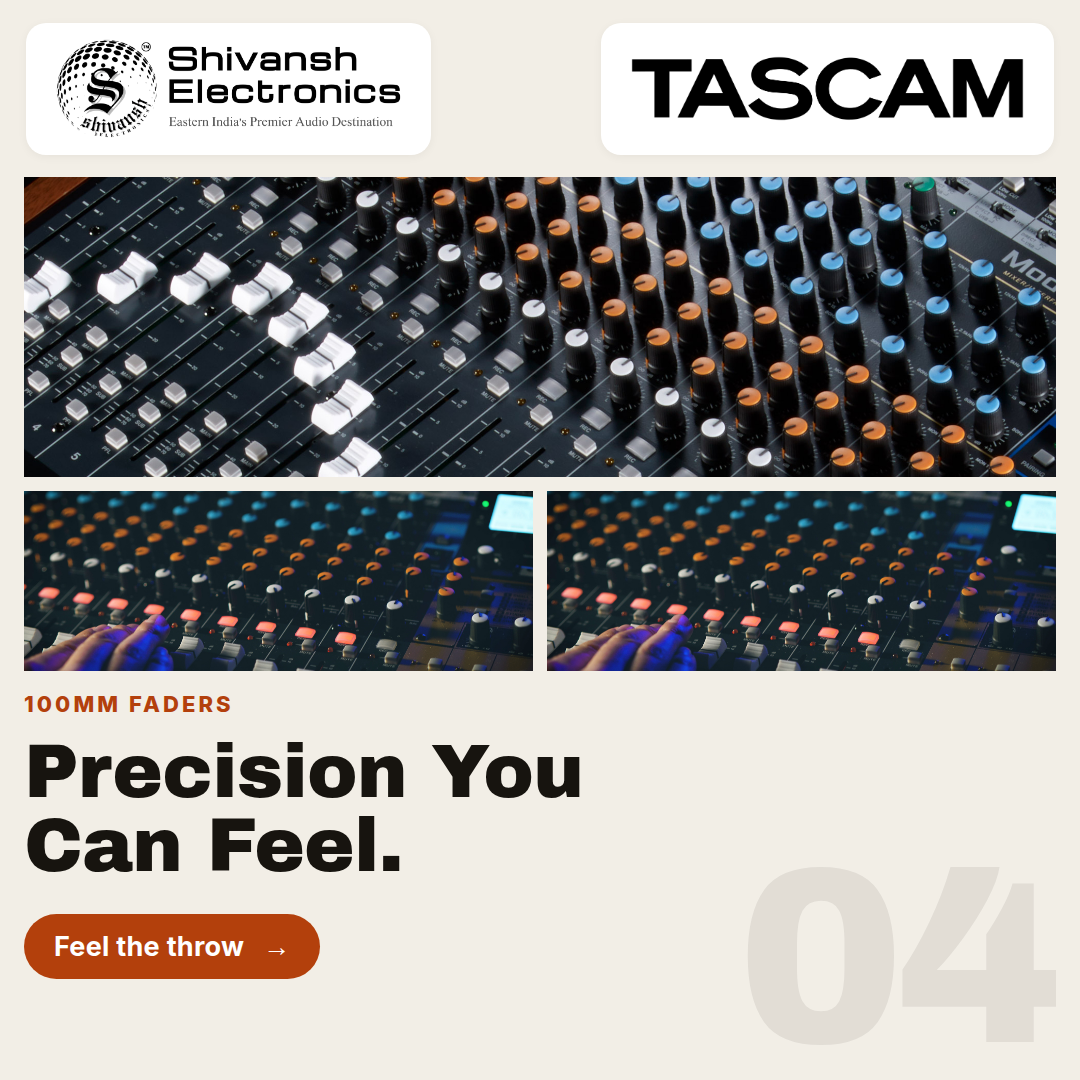
The Model 2400 is a large-format flagship desktop console measuring 680.5 mm (W) × 132.5 mm (H) × 568.0 mm (D) and weighing 14.0 kg — the largest and heaviest console in the entire Model series, exceeding the Model 24's footprint and mass by a meaningful margin. This additional scale is a direct consequence of the console's expanded feature set: insert points across twelve channels rather than two, a fifth aux send, four stereo subgroup buses, dedicated talkback and MIDI hardware, and comprehensive monitoring infrastructure including dual headphone jacks and dedicated control room outputs all require physical panel real estate that the Model 24's more compact layout does not allocate.
As with the Model 24, the Model 2400 is a desktop unit intended to sit at a dedicated mixing position where the engineer has simultaneous hands-on access to the full channel strip array. The larger chassis reflects the console's studio-first design brief: a commercial studio installation has the fixed desk space and permanent placement that a large-format console demands, in exchange for the complete tactile control surface that a rack-mounted interface cannot replicate.
3. MICROPHONE PREAMPS — DOCUMENTED AUDIOPHILE-GRADE PERFORMANCE
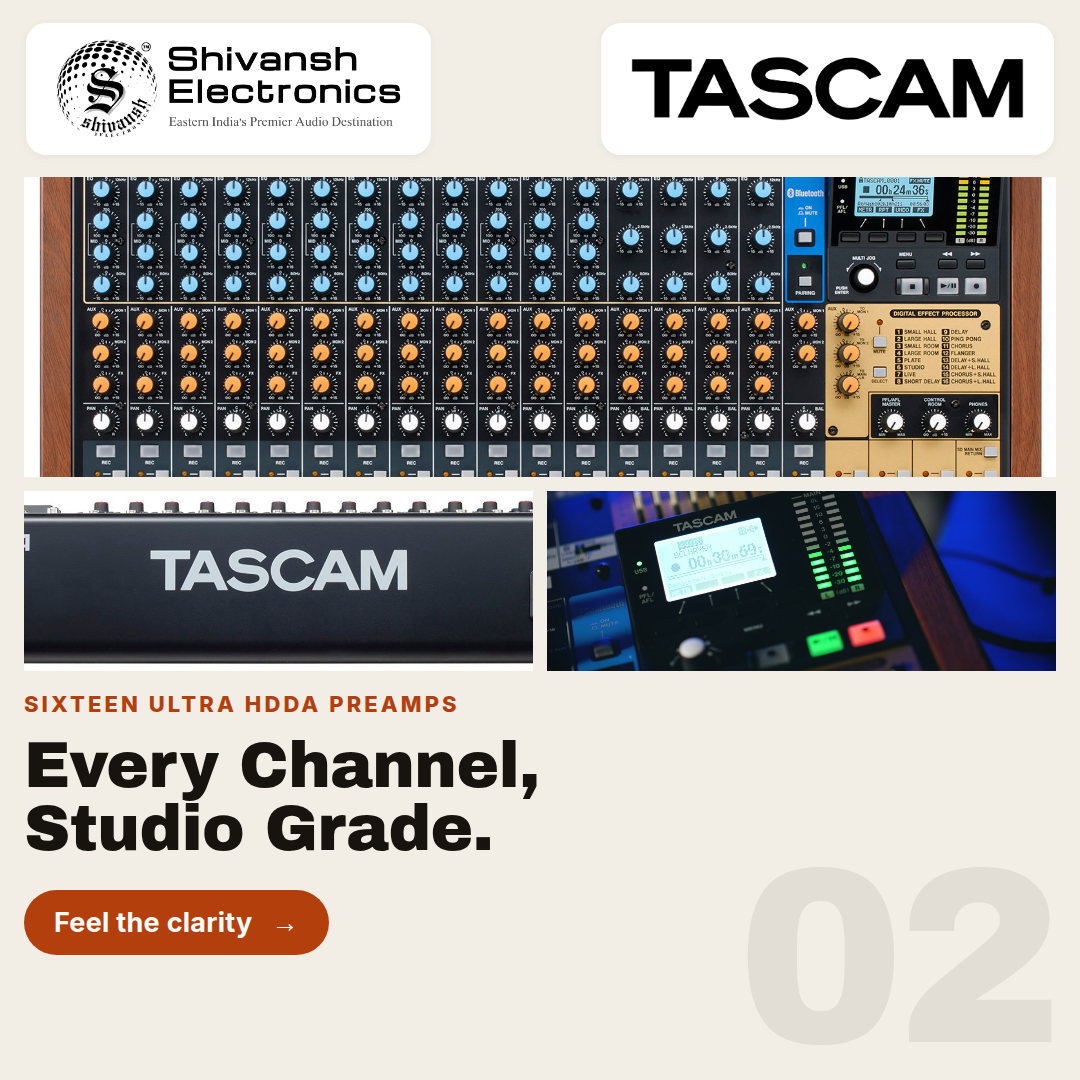
The Model 2400 is engineered with 16 Ultra HDDA (High Definition Discrete Architecture) preamps and boasts the most rigorously documented specifications of any console in the Model series. The preamp delivers a maximum gain of 74 dB from mic input to main output — a substantially wider gain window than the Model 24's 50 dB adjustable range — giving the console the headroom to handle both the quietest ribbon microphones and distant ambient sources without an external gain-boosting device. Nominal input level is specified at -8 dBu (at LEVEL "MIN"), and input impedance is documented separately for mono and stereo paths: 22 kΩ for mono channels and 11 kΩ for stereo-paired channels.
The preamp's noise performance is exceptionally low: an Equivalent Input Noise (EIN) of -128 dBu (measured at 150 Ω source impedance, maximum gain, A-weighted) means that even the most sensitive microphone placements — distant room mics, quiet acoustic instruments, whispered vocal takes — will not encounter audible preamp self-noise. Total Harmonic Distortion (THD) measures 0.003% (mic in to main out, +2 dBu, 1 kHz), a figure that places the Model 2400's preamp performance in the same tier as dedicated standalone boutique preamplifier units costing several times the console's price. This is a meaningful distinction from the Model 24, whose published specifications do not include a documented THD or EIN figure — the Model 2400's documentation reflects its positioning as a console for engineers who need to specify and defend preamp performance in a commercial studio context.
4. INSERT POINTS & OUTBOARD HARDWARE INTEGRATION
Where the Model 24 provides insert points on only channels 1 and 2, the Model 2400 extends balanced TRS send/return insert points across the first twelve channels — a substantial expansion that reflects the console's studio-integration design brief. Twelve simultaneous insert points mean an engineer can patch outboard compressors, equalisers, gates, or other analogue processors directly into the signal path of an entire drum kit, a full vocal session with multiple backing singers, or any combination of individually-miked sources that benefit from dedicated hardware processing before the signal reaches the analogue-to-digital converter — a workflow that would require constant re-patching on a console with only two insert points.
This insert architecture is what allows the Model 2400 to function as a genuine hub for a studio's outboard hardware collection — vintage compressors, boutique equalisers, tube-driven processors, and other analogue gear that many engineers consider essential to a professional sound — rather than confining outboard processing to only the one or two channels most consoles in this format allocate for it.
5. BUS ARCHITECTURE — 5 AUX SENDS & 4 STEREO SUBGROUPS
The Model 2400's routing matrix is vastly expanded over the Model 24, featuring five aux sends — four discrete analogue auxiliary buses plus an internal FX send — alongside four stereo subgroups and the Main L/R bus. This is a genuine large-format studio console bus architecture: four independent aux sends allow the engineer to construct multiple simultaneous headphone or monitor cue mixes for performers (a drummer's mix, a vocalist's mix, a full-band cue mix, and a producer's reference mix, for example) while the internal FX send remains dedicated to reverb, delay, or other time-based processing, entirely separate from the performer monitor buses.
The four stereo subgroups add a capability the Model 24 does not offer at all: the ability to bus entire instrument sections — all drum microphones to Sub 1/2, all vocal channels to Sub 3/4, for example — for parallel analogue compression, shared EQ, or simplified fader-group control during a mix. This subgrouping is standard large-format console practice in professional studios, where an engineer frequently wants to apply a single compressor or EQ setting across an entire drum kit's summed signal rather than processing each microphone individually, or wants a single fader to control an entire backing-vocal stack's level without adjusting each channel independently.
6. HUI/MCU DAW CONTROL & REC READY INTEGRATION
The Model 2400's reinstatement of HUI/MCU DAW transport control is its single most significant differentiator from the Model 24. HUI (Human User Interface) and MCU (Mackie Control Universal) are the two dominant control-surface protocols supported natively by virtually every major DAW — Pro Tools, Logic Pro, Cubase, Studio One, Ableton Live, and others — and a console offering native emulation of both means an engineer can arm tracks, trigger transport (play, stop, record, rewind, fast-forward), jog the timeline, and control REC READY status for individual channels directly from the console's physical controls, without reaching for a mouse or keyboard.
This capability is what allows the Model 2400 to function simultaneously as a large-format analogue mixing desk and as the primary tactile control surface for an entire DAW session — a combination that neither the Model 24 (which omits DAW control) nor a typical dedicated control surface (which typically omits large-format analogue mixing) can offer alone. For an engineer moving fluidly between tracking, comping, and mixing within a single session, this means the physical console remains the single point of interaction throughout the entire production process.
7. TALKBACK, MIDI & STUDIO COMMUNICATION INFRASTRUCTURE
The Model 2400 includes a dedicated talkback XLR input — a studio-standard feature for control-room-to-live-room communication that the Model 24 does not include. In a professional studio context, talkback is not a convenience feature but a core operational requirement: it allows the engineer to speak directly to performers in the live room through their headphone monitor mix, without needing a separate intercom system or shouting through a closed control-room door, and it is standard equipment on virtually every commercial studio console at this format tier.
MIDI In/Out ports provide synchronisation and control connectivity for hardware sequencers, drum machines, or other MIDI-equipped studio equipment, while a dedicated 1/4-inch audio click output feeds a metronome click directly to a performer's headphones or in-ear monitors — a specific, practical feature for sessions where a live drummer needs to stay locked to a programmed tempo grid alongside MIDI-sequenced instrumentation, a common requirement in modern hybrid production that blends live performance with electronic or sequenced elements.
8. PRE/POST EQ ROUTING & COMPRESSOR/EQ BYPASS
The Model 2400 supports selectable pre/post EQ routing independently for both the USB recording stream and the MTR (SD card) recording stream — a routing-flexibility feature that gives the engineer explicit control over whether a channel's analogue EQ processing is captured in the recorded signal or applied only to the monitored/mixed output. This distinction matters significantly in professional tracking sessions: an engineer may want completely clean, unprocessed signal captured to the DAW (pre-EQ routing) so that all tonal decisions remain fully reversible in post-production, while simultaneously wanting the EQ'd, processed signal feeding the headphone monitor mix so performers hear a pleasing, controlled sound while tracking.
Furthermore, the console supports compressor and EQ bypass functions specifically for the multitrack (MTR) return paths — meaning that when previously recorded tracks are played back through the console for mixing or further processing, the engineer can choose whether the channel's compressor and EQ are engaged on that returning signal or bypassed entirely. This granular control over exactly where and when analogue coloration is applied during a hybrid digital/analogue mixdown is a defining feature of a professional studio console, and it is not present on the Model 24's more streamlined signal path.
9. MONITORING INFRASTRUCTURE — CONTROL ROOM OUTPUTS & DUAL HEADPHONES
The Model 2400 rounds out its studio credentials with comprehensive monitoring infrastructure absent from the Model 24: dedicated control room outputs (a separate signal path from the main mix bus, allowing the engineer to monitor at different levels or through different processing than what is being recorded or sent to performers), dual headphone jacks (supporting two simultaneous headphone monitoring positions — useful when an assistant engineer, a producer, or a visiting artist needs an independent headphone feed alongside the primary engineer), and a built-in talkback XLR input feeding into the overall monitoring signal chain.
This monitoring architecture reflects standard commercial studio console design, where the control room's own listening environment is treated as a distinct signal path from whatever mix is being recorded or sent to the live room — a separation of concerns that becomes operationally important once a session involves multiple listeners with potentially different monitoring needs simultaneously.
10. INTERNAL RECORDER, USB INTERFACE & DIGITAL TRANSPORT
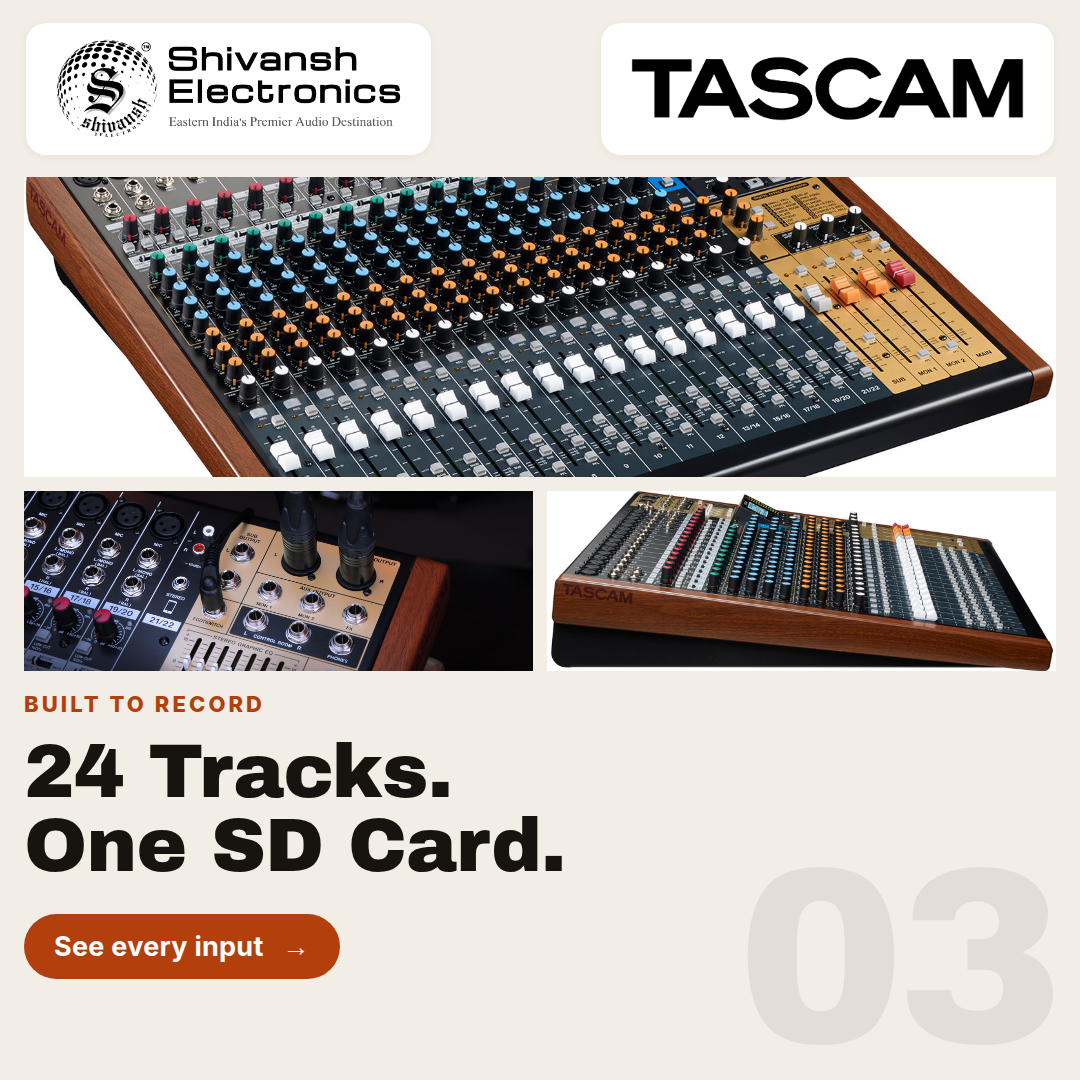
Functionally, the Model 2400 shares its core recording and interface architecture with the Model 24: 24 simultaneous tracks (22 discrete analogue inputs plus the main left/right stereo mix) captured to SDXC media at 24-bit resolution, with the console's sample rate spanning 44.1 kHz and 48 kHz. SDXC support explicitly includes punch in/out capability, allowing a specific passage of a performance to be re-recorded without disturbing the surrounding already-approved material on the other tracks — a standard professional overdubbing workflow.
The console simultaneously functions as a 24-in/22-out USB audio interface, transporting the full analogue channel array to a connected computer over USB Audio Class 2.0 connectivity — the same dual-mode operation found on the Model 24, meaning the Model 2400 never forces a choice between DAWless SD-card reliability and computer-based DAW recording. What distinguishes the Model 2400's USB implementation from the Model 24's is the addition of HUI/MCU control data running alongside the audio transport, giving the connected DAW both the full audio channel array and complete transport/REC READY control from the same physical console.
11. CONVERTER PERFORMANCE & FREQUENCY RESPONSE
The Model 2400's converter section operates at 44.1 kHz or 48 kHz with 24-bit resolution throughout — a fixed 24-bit path rather than the 16-bit/24-bit selectable option found on the Model 24, reflecting the console's studio-first positioning where maximum bit-depth fidelity is assumed as the default rather than offered as a storage-saving option. Crosstalk between channels measures -80 dB (1 kHz, band-pass filtered), and frequency response across the analogue signal path spans 20 Hz to 30 kHz (+0.5/-1.0 dB) — a wide, well-controlled response that extends comfortably beyond the audible range on both ends, ensuring the console does not impose its own tonal signature on material passing through it.
These figures, published explicitly by TASCAM for the Model 2400 and absent from the Model 24's own specification sheet, are consistent with the console's positioning as the technically documented flagship of the Model series — a console engineers can specify with confidence in a commercial studio proposal or technical rider, where documented converter and analogue-path performance figures are frequently a client or venue requirement.
12. PRODUCT FAMILY CONTEXT — THE MODEL 2400 WITHIN THE TASCAM MODEL SERIES
The TASCAM Model family is a tiered, progressive ecosystem of hybrid analogue/digital consoles that scale linearly in physical footprint, I/O capacity, and professional feature depth. The Model 12 is the compact, highly integrated entry point — 8 mic preamps, 12-track SD recording, and unique in the lower tier for HUI/MCU DAW transport emulation, 5-pin MIDI I/O, and Bluetooth 5.0. The Model 16 steps up to 10 mic preamps, 14 analogue inputs, and 16-track SD recording, trading DAW control for a wider analogue footprint suited to small bands and rehearsal spaces. The Model 24 expands this architecture to 16 mic preamps, 22 total inputs, and 24-track SD recording, serving as a large-format analogue summing engine and live-sound front-of-house console — but without DAW control.
The Model 2400 sits at the top, retaining the Model 24's 24-track architecture and 22-channel analogue layout while critically re-integrating the HUI/MCU DAW control found on the Model 12, and adding capabilities present on no other console in the family: insert points across twelve channels rather than two, a fifth aux send, four stereo subgroups, dedicated talkback, MIDI I/O with click output, dual headphone jacks, control room outputs, and selectable pre/post EQ routing with compressor/EQ bypass on MTR returns. As a buyer moves up the Model range, channel count and preamp availability increase linearly — but DAW control capability skips the middle tier entirely, existing only on the highly integrated Model 12 and the flagship Model 2400, with the Model 2400 uniquely combining that DAW control with the series' maximum channel count and its most extensively documented preamp and converter performance.
TASCAM MODEL SERIES — KEY DIFFERENTIATORS
| FEATURE | MODEL 12 | MODEL 16 | MODEL 24 | MODEL 2400 |
|---|---|---|---|---|
| Mic Preamps (Ultra HDDA) | 8 | 10 | 16 | 16 |
| Total Analogue Inputs | 10 | 14 | 22 | 22 |
| Simultaneous SD Tracks | 12 | 16 | 24 | 24 |
| Preamp Max Gain | 74 dB | 0–50 dB | 50 dB adj. | 74 dB |
| Documented EIN / THD | -128 dBu / 0.003% | Not published | Not published | -128 dBu / 0.003% |
| HUI/MCU DAW Control | Yes | No | No | Yes |
| Insert Points | Ch 1–2 | Ch 1–2 | Ch 1–2 | Ch 1–12 |
| Aux Sends | — | FX bus | 3 (Mon 1, Mon 2, FX) | 5 (4 Aux + FX) |
| Stereo Subgroups | — | — | — | 4 |
| Talkback | — | — | — | XLR input |
| MIDI I/O + Click Out | 5-pin MIDI | — | — | Yes, + click out |
13. SPECIFICATION CROSS-VALIDATION
13.1 Simultaneous Track Count vs. Analogue Input Count
TASCAM specifies 24 simultaneous recorded tracks against 22 total analogue inputs. As with the Model 24, the arithmetic is: 22 discrete analogue inputs (12 mono + 4 stereo-paired + dedicated stereo aux) plus the main stereo (left/right) mix bus = 24 total tracks captured simultaneously. This is the consistent Model-series convention across every console in the family, and confirms the Model 2400's 24-track figure is not a discrepancy but the standard counting method that includes the printed stereo mix as two additional simultaneous tracks. No discrepancy.
13.2 Preamp Gain vs. Nominal Input Level
The Model 2400 specifies 74 dB of maximum gain (mic to main out) alongside a nominal input level of -8 dBu (at LEVEL "MIN"). These two figures describe different points in the signal chain and are not directly comparable as a subtraction: the 74 dB figure is the total gain available from the mic preamp through to the main output bus at unity fader and pan settings, while the -8 dBu nominal input level describes the reference input level at the gain control's minimum setting — the starting point from which the 74 dB of additional gain can be applied. This is standard preamp specification practice, consistent with how the Model 12's identical 74 dB gain figure is documented, and there is no internal inconsistency between the two published numbers.
13.3 Frequency Response Asymmetry (+0.5/-1.0 dB)
The Model 2400's frequency response is specified as 20 Hz–30 kHz with an asymmetric tolerance of +0.5/-1.0 dB. This asymmetric figure — a tighter positive tolerance than negative tolerance — is a normal characteristic of analogue circuit design across a wide frequency band: most analogue signal paths exhibit a very slight roll-off at the frequency extremes (contributing to the larger -1.0 dB figure at the band edges) while rarely exhibiting significant peaking above the nominal response (keeping the +0.5 dB figure tight). This is a standard, expected specification pattern for a professional analogue console and does not indicate any design flaw or inconsistency. No discrepancy.
14. IDEAL APPLICATIONS & USE CASES
- Commercial Recording Studio Centrepiece: 16 preamps for full-band tracking, pre-EQ USB routing for clean DAW stems, custom headphone mixes via 5 aux sends, HUI/MCU for mouse-free session control.
- Analogue Summing with Outboard Hardware: 12 insert points for vintage compressors and EQs, 4 stereo subgroups for parallel drum/vocal bus processing.
- Live Broadcasting with Multitrack Archiving: Compressor/EQ bypass on MTR returns for raw post-production stems alongside a processed broadcast feed.
- MIDI-Synchronised Hybrid Production: MIDI Out for hardware sequencer clock, dedicated click output for a live drummer locked to a programmed grid.
- Solo Overdubbing and Self-Production: Punch in/out support for precise re-recording, 4 stereo subgroups for internal vocal-stack bouncing.
- Mix Engineer Working with Session Vocalists/Bands: Dual headphone jacks for engineer plus producer/artist, dedicated talkback for live-room communication.
- Post-Production Facility with Outboard Racks: Control room outputs separate from recording/broadcast feed, documented -80 dB crosstalk for critical multitrack isolation.
HOW TO READ THIS DOCUMENT
This document is the operational companion to the TASCAM Model 2400 Product Description and Technical Specifications document. Where the Specs document answers "what does the Model 2400 do and how is it measured?", this document answers "how do I actually deploy and use the Model 2400 in my specific professional environment?" Every workflow section describes a named scenario with physical setup, signal routing, configuration detail, and the specific features of the Model 2400 that make that workflow efficient or even possible. Together, the two documents constitute a complete technical and operational reference for the TASCAM Model 2400.
Three defining workflow advantages of the Model 2400 appear repeatedly across the scenarios in this document. First, it is the only console in the Model series tier that combines the full 22-channel / 24-track analog architecture of the Model 24 with dedicated HUI/MCU DAW transport control — a combination that lets an engineer run an entire tracking or mixing session, arming tracks and triggering playback, without leaving the console surface. Second, its expanded routing matrix — 5 Aux sends (4 analog buses plus an internal FX send), 4 stereo subgroups, and TRS insert points on channels 1 through 12 — gives it a genuine outboard-integration and monitor-mix capacity beyond the standard Model 24. Third, its selectable pre/post EQ routing and independent compressor/EQ bypass on the multitrack return paths mean the same session can simultaneously deliver a fully processed mix to one destination — a broadcast feed, a live PA, a stream — while a completely clean, unprocessed set of stems is preserved on another, without any re-patching.
Each workflow section is structured as follows: a scenario description, a physical and signal-routing walkthrough, a discussion of which Model 2400 features are most critical in that environment, and a summary table for use as a practitioner's checklist. Select the workflows most relevant to your application — not every section will apply to every reader.
WORKFLOW 1 — COMMERCIAL RECORDING STUDIO CENTERPIECE
Scenario: Full-Band Live Tracking with Hands-Free DAW Control
In a commercial recording studio, the TASCAM Model 2400 is deployed as the primary analog front end and control surface for a full-band tracking session. The 16 Ultra HDDA microphone preamplifiers capture the entire ensemble — drums, bass, guitars, and lead and backing vocals — with each channel routed into Pro Tools via the console's 24-in / 22-out USB connection. Because the Model 2400 supports selectable pre-EQ routing on the USB feed, the engineer sends Pro Tools completely clean, dry signal straight from the Ultra HDDA preamps, preserving every option for the mix stage regardless of what EQ or dynamics settings are dialed in at the console for monitoring.
With musicians in the live room, the engineer builds individual headphone mixes using the console's 5 Aux sends: four discrete analog aux buses cover drums, bass, guitar, and vocal cue mixes, while the fifth — the internal FX send — feeds a shared reverb return that every performer can dial into their own mix. Communication between the control room and the live room runs through the dedicated XLR talkback input, eliminating the need for a separate intercom system. Once tracking begins, the engineer uses the console's HUI/MCU transport and REC READY control to arm tracks, trigger playback, and start recording directly from the Model 2400's surface — the entire session can run without the engineer touching a mouse.
Workflow Summary: Full-Band Live Tracking
| WORKFLOW ELEMENT | DETAILS / CONFIGURATION |
|---|---|
| Preamps in use | 16 Ultra HDDA (all channels, +48V phantom as needed) |
| USB routing | Pre-EQ selected — clean, dry signal to Pro Tools |
| Cue mixes (Aux 1–4) | Drums, bass, guitars, lead/backing vocals — one bus each |
| Shared reverb (Aux 5 / internal FX) | Available to all performer headphone mixes |
| Control room communication | Dedicated XLR talkback input |
| DAW control | HUI/MCU transport, REC READY, track arming — no mouse required |
| Backup capture | Simultaneous 24-track SDXC recording (22 inputs + stereo mix) |
| Sample rate | 44.1 or 48 kHz, 24-bit |
WORKFLOW 2 — ANALOG SUMMING & OUTBOARD HARDWARE INTEGRATION
Scenario: Mixdown Through the Analog Domain with Vintage Outboard
During the mixdown phase of a project, a mixing engineer returns 22 individual tracks from Logic Pro back into the Model 2400 via its USB connection, treating the console as a large-format analog summing bus. Because the first 12 channels feature 1/4-inch TRS insert points, the engineer patches external analog outboard hardware — a pair of 1176-style compressors across the drum overheads, Pultec-style EQs on the bass and vocal channels — directly into the signal path of the returning stems, adding a stage of analog color and dynamic control that stays entirely outside the digital domain.
The console's 4 stereo subgroups organize the return channels for efficient bus processing: all drum tracks are routed to Subgroup 1/2 for shared parallel compression, while lead and backing vocals are isolated on Subgroup 3/4 for independent bus treatment. The summed analog mix is then printed back into the DAW as the final master, having passed through the Ultra HDDA input stage, the outboard insert chain, and the subgroup buses — a workflow that gives the finished mix a cohesive analog character that purely in-the-box summing cannot replicate.
Workflow Summary: Analog Summing Session
| WORKFLOW ELEMENT | DETAILS / CONFIGURATION |
|---|---|
| Source material | 22 stems returned from DAW via USB |
| Insert points used | Channels 1–12 (TRS send/return) |
| Outboard patched | Analog compressors and EQs (1176-style, Pultec-style) |
| Subgroup 1/2 assignment | Drum tracks — parallel bus compression |
| Subgroup 3/4 assignment | Lead and backing vocals |
| Signal path | Ultra HDDA input → outboard inserts → subgroup buses → Main L/R |
| Final output | Summed stereo master printed back to DAW |
| EQ routing | Post-EQ available where console coloration should print into the return |
WORKFLOW 3 — LIVE BROADCAST WITH MULTITRACK ARCHIVING
Scenario: Televised Performance Mixing with Clean Archival Stems
An audio crew mixing a live televised musical performance relies on the Model 2400's full 22-input array to capture the stage — every microphone, DI, and line source the performance requires. The mix that leaves the console for the broadcast truck needs to sound finished: EQ'd, compressed, and ready for air. At the same time, the production wants completely uncolored, raw multitrack stems preserved for a post-production remix once the broadcast has aired.
The Model 2400 resolves this dual requirement without any additional hardware. The engineer applies the console's compressor/EQ bypass functions to the multitrack return paths, ensuring the live feed sent to the video truck carries the console's analog EQ and dynamics processing exactly as mixed, while the SDXC card records the same 24 tracks completely dry and unprocessed. Later, the post-production team works from stems with full latitude to remix, rebalance, or reprocess the performance from scratch — something a printed, already-processed broadcast mix could never offer.
Workflow Summary: Live Broadcast with Archival Multitrack
| WORKFLOW ELEMENT | DETAILS / CONFIGURATION |
|---|---|
| Live inputs captured | 22-channel array (full stage) |
| Broadcast feed | Processed — console EQ and dynamics applied |
| MTR return bypass | Compressor/EQ bypass engaged on archival return paths |
| SDXC recording | 24 tracks (22 inputs + stereo mix), fully unprocessed |
| Broadcast destination | Video truck / outside broadcast feed |
| Archival purpose | Full remix latitude for post-production |
| Bit depth / sample rate | 24-bit, 44.1/48 kHz |
WORKFLOW 4 — MIDI-SYNCHRONIZED ELECTRONIC & HYBRID PRODUCTION
Scenario: Central Sequencing Hub for Hardware Synthesizers
An electronic music producer uses the Model 2400 as the central hub for a hardware-based studio, with an array of analog and digital synthesizers connected across the console's 22 analog inputs. Rather than relying on a DAW to keep outboard sequencers in time, the producer uses the Model 2400's MIDI Out port to transmit clock data directly to the external hardware sequencers, keeping every synthesizer locked to a single master tempo without routing MIDI through a computer.
Where a live drummer performs alongside the sequenced material, the console's dedicated 1/4-inch audio click output feeds a metronome click directly into the drummer's in-ear monitors — a critical detail, since a human performance drifting even slightly against a rigid MIDI grid becomes immediately audible once instruments are locked to a sequencer. The entire hybrid performance, human and machine alike, is then captured to the 24-track SDXC recorder, preserving the full multitrack session for later mixing.
Workflow Summary: MIDI-Synchronized Production Rig
| WORKFLOW ELEMENT | DETAILS / CONFIGURATION |
|---|---|
| Synth inputs | Up to 22 analog channels (synthesizers, drum machines) |
| Master clock output | MIDI Out — clock data to external hardware sequencers |
| Drummer click feed | 1/4-inch audio click output to in-ear monitor system |
| Recording | 24-track SDXC capture (22 inputs + stereo mix) |
| Synchronization goal | Human performance locked to MIDI-sequenced grid |
| Computer required | No — fully hardware-synchronized signal chain |
WORKFLOW 5 — SOLO SONGWRITER OVERDUBBING & DAWLESS CAPTURE
Scenario: Full Song Production Without a Computer
A solo artist builds an entire song on the Model 2400 without ever connecting a computer. The rhythm section — drums, bass, and a scratch guide vocal — is tracked first, recorded directly to the internal SDXC card. From there, the artist works through overdub after overdub: lead vocal, guitar solos, harmony parts, all captured the same way, with the console's Ultra HDDA preamps handling every source from a single condenser microphone to a re-amped guitar DI.
When a guitar solo take needs a fix rather than a full re-record, the console's punch-in/out support lets the artist re-record a specific ten-second section cleanly, dropping in and out of record on the existing track without disturbing the surrounding performance. As backing vocal layers accumulate, the 4 stereo subgroups become a channel-management tool: multiple harmony takes are bounced down internally to a single stereo pair, freeing up physical channels for the next round of overdubs without ever leaving the standalone recording environment.
Workflow Summary: Solo Overdubbing Session
| WORKFLOW ELEMENT | DETAILS / CONFIGURATION |
|---|---|
| Computer required | No — standalone SDXC recording throughout |
| Preamps in use | Ultra HDDA, as needed per overdub pass |
| Punch-in/out | Used for targeted fixes within existing takes |
| Backing vocal management | Bounced via Subgroup 3/4 to a single stereo pair |
| Channel reuse | Freed channels available for additional overdub layers |
| Recording format | 24-bit / 44.1 or 48 kHz WAV to SDXC |
WORKFLOW 6 — POST-PRODUCTION, ADR & FILM DUBBING
Scenario: Dialogue Replacement Session with Booth Communication
A post-production facility uses the Model 2400 for an automated dialogue replacement (ADR) session, re-recording an actor's dialogue lines to match picture. The actor's microphone feeds one of the 16 Ultra HDDA preamps, while the console's TRS insert points on channels 1 through 12 allow the engineer to patch a dedicated de-esser or fast-acting limiter directly into the dialogue channel — protecting against plosives and sudden level spikes during performance takes without adding a separate rack unit to the signal path.
Communication with the actor runs through the dedicated XLR talkback input, letting the engineer or director cue lines and give direction between takes, while one of the console's dual headphone jacks serves the engineer at the desk and the second serves a director or supervising sound editor sitting alongside. The engineer uses the Model 2400's HUI/MCU transport control to navigate scenes, arm the dialogue track, and punch record in sync with picture playback — keeping both hands on the physical controls through every take rather than reaching for a mouse.
Workflow Summary: ADR & Dialogue Replacement
| WORKFLOW ELEMENT | DETAILS / CONFIGURATION |
|---|---|
| Actor mic input | Ultra HDDA preamp channel |
| Insert processing | De-esser or limiter patched via channel insert (ch. 1–12) |
| Booth communication | Dedicated XLR talkback input |
| Monitoring | Dual headphone jacks (engineer + director/supervising editor) |
| Transport control | HUI/MCU — scene navigation, track arming, punch record |
| EQ routing | Pre-EQ selectable for a clean dialogue capture to the DAW |
WORKFLOW 7 — HOUSE OF WORSHIP PRODUCTION
Scenario: Multi-Mic Worship Service with Standalone Archival Recording
A house of worship deploys the Model 2400 to mix its weekly services, with the worship team's vocals, acoustic and electric instruments, and keyboards feeding the console's 16 Ultra HDDA preamps. Four of the console's Aux sends provide independent in-ear or wedge monitor mixes for the musicians, while the fifth — the internal FX send — supplies a shared vocal reverb that the sound team dials in once and every vocal mic can access.
The dedicated talkback input lets the volunteer sound team communicate with the stage between songs without an additional intercom system, and the console's Bluetooth input handles walk-in music or an announcement audio feed from a phone or tablet without occupying an analog channel. Every service is captured to the internal SDXC recorder as a full 24-track multitrack session — with no computer required — giving the media team a complete archive to draw from for the church's podcast feed or online sermon library.
Workflow Summary: House of Worship Service
| WORKFLOW ELEMENT | DETAILS / CONFIGURATION |
|---|---|
| Worship team inputs | Up to 16 Ultra HDDA mic/instrument channels |
| Musician monitor mixes | 4 discrete Aux sends (in-ear or wedge feeds) |
| Shared vocal reverb | Aux 5 / internal FX send |
| Stage communication | Dedicated XLR talkback input |
| Walk-in / announcement audio | Bluetooth input (AAC/SBC) |
| Service archive | 24-track SDXC recording, standalone (no computer) |
| Archive use | Podcast feed / sermon library sourcing |
WORKFLOW 8 — PODCAST STUDIO & MULTI-GUEST LIVE STREAMING
Scenario: Multi-Host Recording with Simultaneous Live Stream Output
A podcast production sets up the Model 2400 as the console for a multi-host show, with each host and in-studio guest on a dedicated Ultra HDDA microphone channel. The console's dual headphone jacks cover two hosts directly at the desk, while additional participants monitor through outputs fed from the Aux send buses. A remote guest's phone call or a pre-recorded intro bed is brought in over the Bluetooth input, keeping every analog mic channel free for live voices.
The 24-in / 22-out USB connection feeds both the recording DAW and streaming software simultaneously from the same console mix, while the producer uses the dedicated talkback input to cue hosts during a live recording without being heard on air. Because the console supports selectable pre/post EQ routing, the team can send a fully processed, broadcast-ready mix to the live stream while the DAW simultaneously captures clean, unprocessed multitrack stems for post-production editing of the on-demand episode.
Workflow Summary: Multi-Host Podcast & Streaming
| WORKFLOW ELEMENT | DETAILS / CONFIGURATION |
|---|---|
| Host/guest mic inputs | Ultra HDDA preamps, one per participant |
| Host monitoring | Dual headphone jacks (2 hosts direct at console) |
| Additional monitor feeds | Aux send buses |
| Remote guest / intro audio | Bluetooth input (AAC/SBC) |
| USB routing | 24-in / 22-out — feeds DAW and streaming encoder simultaneously |
| Live stream feed | Post-EQ — fully processed broadcast mix |
| DAW capture | Pre-EQ — clean multitrack stems for editing |
| Producer cues | Dedicated XLR talkback input |
WORKFLOW 9 — THEATRE & LIVE EVENT MONITOR MIXING
Scenario: Multi-Performer Stage Production with Backing Track Playback
A theatre production uses the Model 2400 at front-of-house for a live musical, with wireless performer microphones, a small pit band, and DI'd instruments filling out the console's 16 Ultra HDDA preamp channels. The 4 Aux sends generate independent monitor mixes for the pit conductor, the lead performers' in-ear packs, and a stage-side wedge mix, while the internal FX send supplies a consistent reverb character across the vocal ensemble for the house mix.
The console's 4 stereo subgroups keep the mix organized during a live show: the pit band is grouped on Subgroup 1/2 for quick overall level moves, while the vocal ensemble sits on Subgroup 3/4. The dedicated talkback input connects the FOH engineer to the stage manager, and the MIDI/click output can distribute a tempo reference to the conductor or a click-dependent backing track cue when the production calls for it. A full 24-track SDXC recording runs throughout the performance as a multitrack archive of the run.
Workflow Summary: Theatre & Live Event FOH
| WORKFLOW ELEMENT | DETAILS / CONFIGURATION |
|---|---|
| Performer/pit inputs | Up to 16 Ultra HDDA channels |
| Monitor mixes | 4 Aux sends (conductor, IEMs, stage wedge) |
| Ensemble reverb | Aux 5 / internal FX send |
| Pit band grouping | Subgroup 1/2 |
| Vocal ensemble grouping | Subgroup 3/4 |
| Stage communication | Dedicated XLR talkback input |
| Tempo/click reference | MIDI Out / 1/4-inch click output |
| Performance archive | 24-track SDXC recording |
WORKFLOW 10 — MIX ROOM & CRITICAL REFERENCE MONITORING
Scenario: Stereo Bus Mastering Chain with Dual Reference Monitoring
A mix engineer uses the Model 2400's channels 1 and 2 as a dedicated stereo mastering path for a final two-track mix, taking advantage of their individual TRS insert points to patch a stereo bus compressor and a mastering EQ directly across the left and right signal. The console's wide 20 Hz – 30 kHz frequency response and -80 dB crosstalk figure keep the summed stereo signal transparent through the additional analog stage, rather than introducing coloration the engineer didn't ask for.
The finished master is monitored through the console's dedicated control room outputs feeding the primary studio monitors, while the dual headphone jacks let the engineer and a client or second engineer reference the mix independently — useful when checking translation on headphones without interrupting the main monitor feed. For projects that call for it, the 4 stereo subgroups provide additional summing points to compare alternate mix passes or parallel-processed versions before the final master is printed.
Workflow Summary: Mix Room Reference Chain
| WORKFLOW ELEMENT | DETAILS / CONFIGURATION |
|---|---|
| Stereo path | Channels 1–2, TRS inserts for compressor/EQ chain |
| Frequency response | 20 Hz – 30 kHz (+0.5/-1.0 dB) |
| Crosstalk | -80 dB (1 kHz, BPF) |
| Primary monitoring | Dedicated control room outputs |
| Reference monitoring | Dual headphone jacks (engineer + client/second engineer) |
| A/B comparison | Additional stereo subgroups for alternate passes |
| Bit depth | 24-bit |