


Brand: TASCAM
TASCAM MODEL 24
Category: Recording Mixers
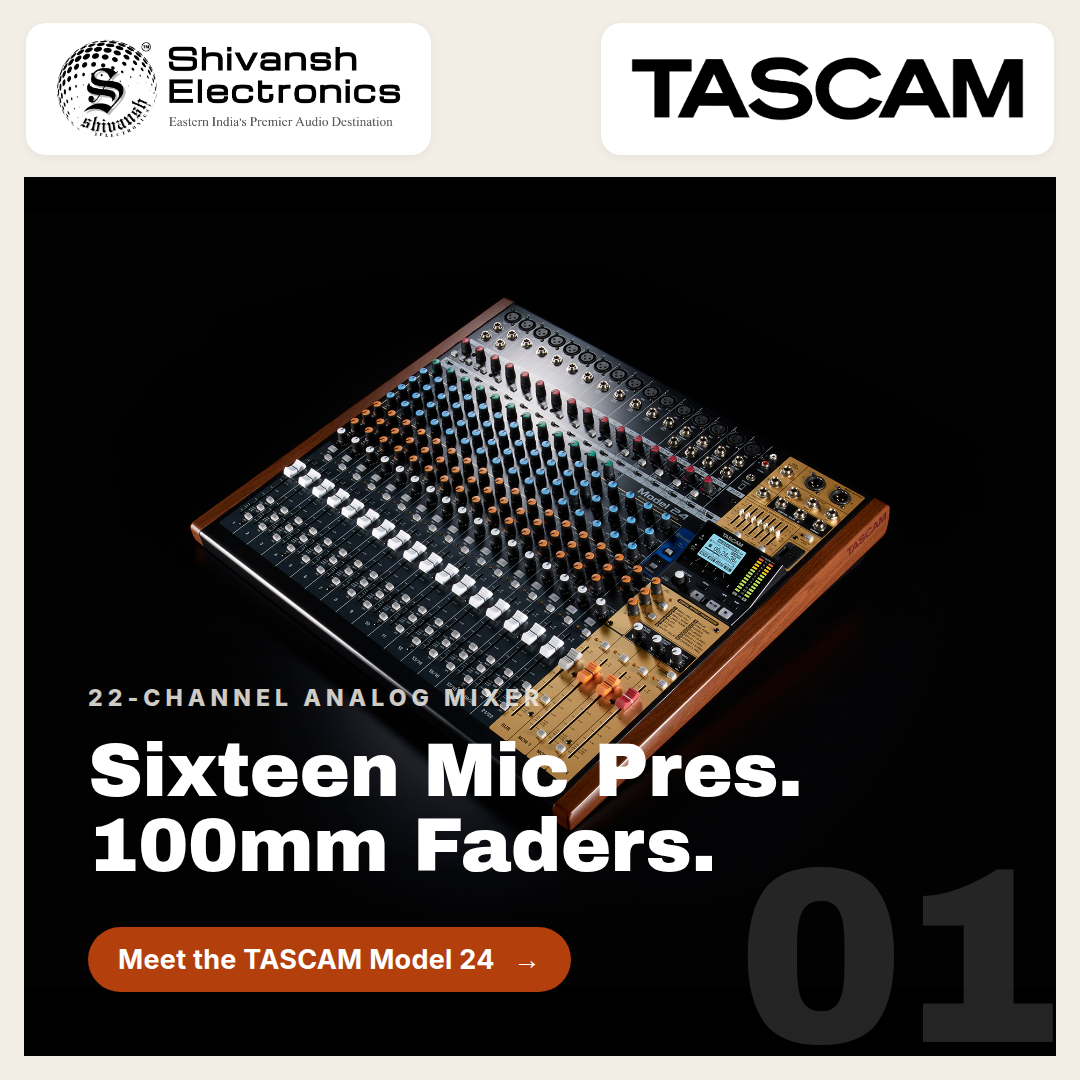
24-channel multi-track live recording console with low-noise preamps, precise EQ, and seamless USB integration for recording and mixing.
PLEASE NOTE: Kindly contact us at +91 98316 62458 / +91 91477 00677 to confirm current availability and the best possible pricing (including any additional discount we may be able to offer) before making any payment.

GENERAL / FORM FACTOR
| SPECIFICATION | DETAILS |
|---|---|
| Product name | TASCAM Model 24 |
| Manufacturer | TASCAM (TEAC Corporation) |
| Product type | Large-format desktop console mixer / 24-track multitrack recorder / 24-in/22-out USB audio interface |
| Form factor | Large-format desktop console |
| Dimensions (W × H × D) | 576 mm × 112.5 mm × 513 mm |
| Weight | 10.2 kg / 22.49 lbs |
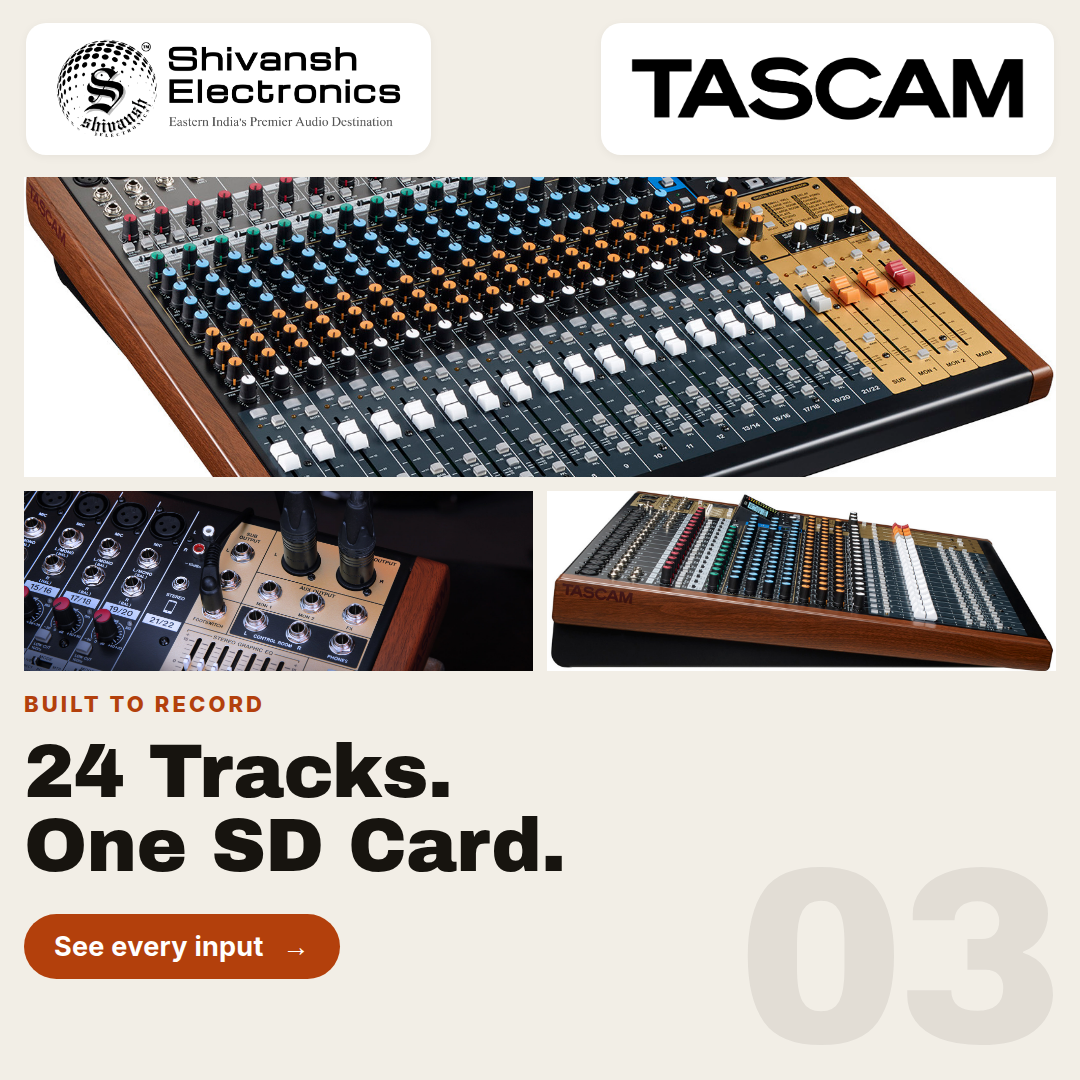
| Total analogue inputs | 22 (12 mono, 4 stereo pairs, 1 dedicated aux stereo) |
| Simultaneous recorded tracks | 24 (22 analogue inputs + 2 stereo mix) |
| HUI/MCU DAW control | Not included (see Model 2400 for DAW transport control) |
MICROPHONE PREAMPS
| SPECIFICATION | DETAILS |
|---|---|
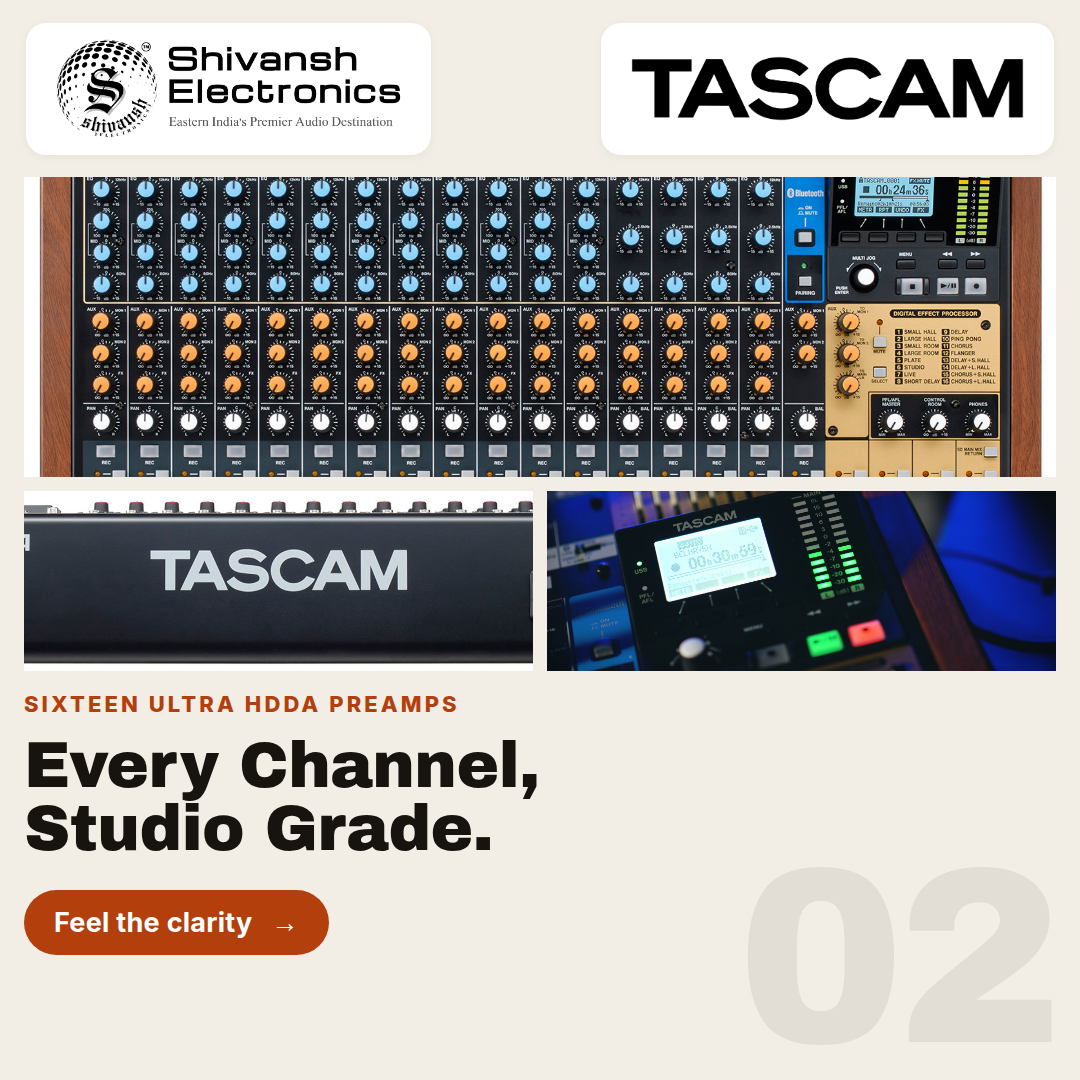
| Preamp type | TASCAM Ultra HDDA (High Definition Discrete Architecture) |
| Number of mic preamps | 16 |
| Connector type | XLR |
| Phantom power | +48V, switchable |
| Gain adjustable range | 50 dB adjustable range (mic) |
| Maximum input level | +10 dBu (mic IN) |
| Minimum input level | -58 dBu (mic IN) |
| Input impedance | 1.8 kΩ (mic IN) |
CHANNEL COUNT & ANALOGUE I/O
| SPECIFICATION | DETAILS |
|---|---|
| Total analogue inputs | 22 (12 mono, 4 stereo pairs, 1 dedicated aux stereo) |
| Mic inputs | 16 XLR (Ultra HDDA) with +48V phantom power |
| Insert points | Channels 1 and 2 (TRS Send/Return) |
| Auxiliary inputs | Bluetooth, 1/8" (3.5mm) Stereo Mini, dual RCA |
| Aux sends | 3 (Monitor 1, Monitor 2, FX) |
| Sample rate | 44.1 kHz / 48 kHz |
| Bit depth | 16-bit / 24-bit |
ONBOARD DSP & EQ
| SPECIFICATION | DETAILS |
|---|---|
| Channel processing | 100 kHz low-cut filters and 3-band sweepable EQs (channels 1–12) |
| Master EQ | 7-band graphic EQ |
| Internal effects | 16 preset digital effects |
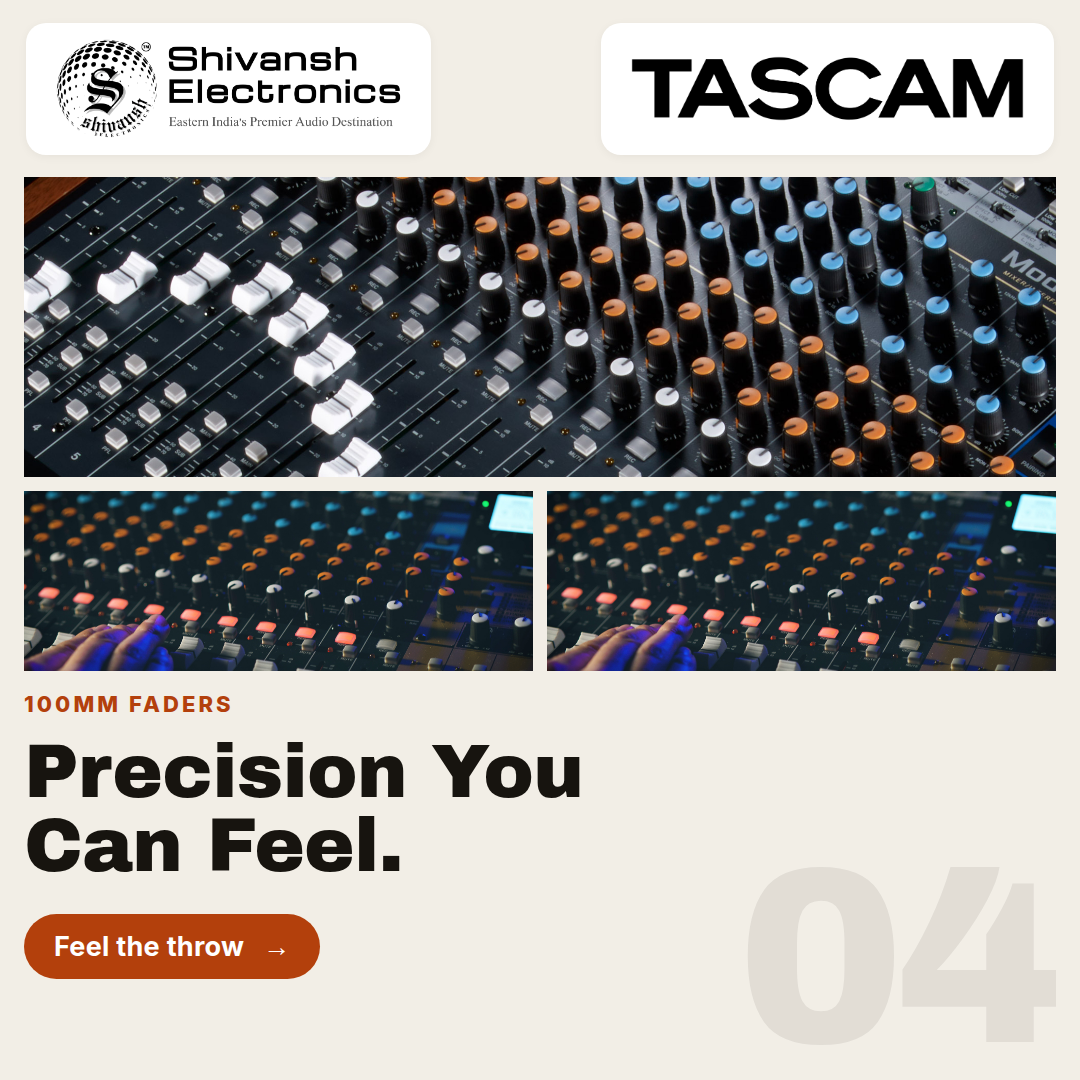
| Fader type | 100mm faders |
RECORDING SPECIFICATIONS
| SPECIFICATION | DETAILS |
|---|---|
| Media supported | SD, SDHC, SDXC (up to 512GB, Class 10+) |
| Simultaneous record | 24 tracks (22 analogue inputs + 2 stereo mix) |
| Recording resolution | 24-bit/48 kHz (16-bit/24-bit; 44.1/48 kHz selectable) |
| File format | WAV |
DIGITAL AUDIO TRANSPORT
| SPECIFICATION | DETAILS |
|---|---|
| USB interface | 24-in / 22-out (Mass-storage / USB Audio Class 2.0) |
| DAW control | Not included (audio transport and analogue mixer only) |
| Class-compliant firmware | Yes — USB Audio Class 2.0 |
SOFTWARE AND CONTROL APPLICATION
| SPECIFICATION | DETAILS |
|---|---|
| Control application | TASCAM Model Mixer Settings Panel |
| Meter bridge | Scalable digital meter bridge, projected onto connected computer monitor |
| Meter sources | Input, MTR (recorder), or USB signal |
PHYSICAL SPECIFICATIONS
| SPECIFICATION | DETAILS |
|---|---|
| Form factor | Large-format desktop console |
| Dimensions (W × H × D) | 576 mm × 112.5 mm × 513 mm |
| Weight | 10.2 kg / 22.49 lbs |
1. PRODUCT OVERVIEW
The TASCAM Model 24 is the largest-format console in TASCAM's Model series of hybrid analogue-digital production systems, combining a 22-channel analogue mixer, a 24-track internal digital multitrack recorder, and a 24-in/22-out USB audio interface into a single desktop chassis. It is the direct scale-up of the Model 12 and Model 16 architecture, engineered specifically to solve the one limitation that smaller consoles cannot: capturing an entire large ensemble — a full band, a horn section, a large praise team — in a single simultaneous pass, with enough microphone preamplification and channel count that no performer or instrument has to be left off the board.
The Model 24 occupies the top of the standard Model tier — above the Model 12 and Model 16 in channel count, preamp count, and physical scale, and positioned as a large-format analogue mixing console first and a recording/interface system second. Where the Model 12 emphasises DAW control and multimedia integration for solo creators, and the Model 16 balances analogue tone-shaping against moderate channel count for bands and rehearsal spaces, the Model 24 is built around raw I/O capacity and a classic, tactile large-format mixing experience: 100mm faders across the entire channel strip, dedicated per-channel EQ and dynamics, and a 7-band graphic EQ on the master bus for acoustic room tuning. It is designed for large live ensembles, professional rehearsal facilities that need to track full bands without exception, and expansive tracking studios.
Three figures define the Model 24's technical position within its category. First, its preamplification: 16 TASCAM Ultra HDDA (High Definition Discrete Architecture) microphone preamps — twice the count of the Model 16 — deliver low-noise, transparent gain across the entire input array, with 50 dB of adjustable gain range and headroom to +10 dBu before clipping. Second, its total channel capacity: 22 analogue inputs (12 monaural, 4 stereo-paired, plus a dedicated stereo auxiliary input for Bluetooth and RCA sources) feed a 24-track simultaneous recorder, calculated as the 22 discrete analogue inputs plus the main left/right stereo mix — meaning a full ensemble performance and the finished stereo mix are captured in the same pass, with no separate bounce-down step required. Third, its digital transport: the console functions as a complete 24-in/22-out USB Audio Class 2.0 interface, delivering the entire analogue mix desk directly into a DAW over a single USB connection, alongside — not instead of — its standalone SD-card recording capability.
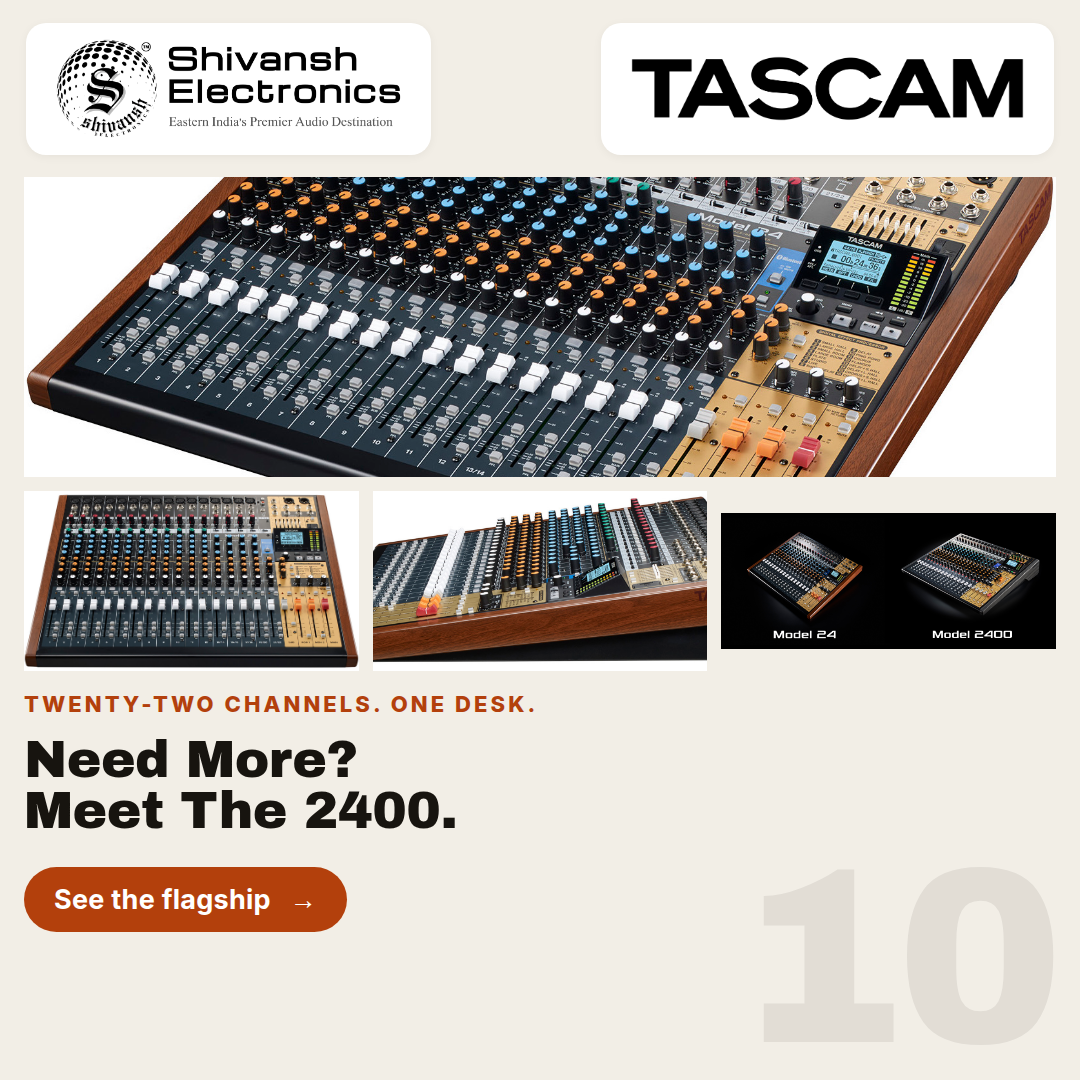
Unlike the flagship Model 2400, the Model 24 does not include HUI/MCU DAW transport control; it is positioned as a dedicated analogue mixer and audio transport interface rather than a tactile DAW controller. This is a deliberate design distinction within TASCAM's own product family: the Model 24 is optimised for the workflow of mixing and capturing a live performance or a large tracking session on its own tactile analogue surface, while DAW-integrated mixdown control is reserved for the Model 2400 above it. Firmware enhancements have added compatibility with the TASCAM Model Mixer Settings Panel application, which projects a scalable digital meter bridge onto a connected computer monitor — giving engineers visual peak-hold monitoring across all 24 channels of input, MTR, or USB signal without needing a dedicated outboard meter bridge.
2. CHASSIS, FORM FACTOR & PHYSICAL SCALE
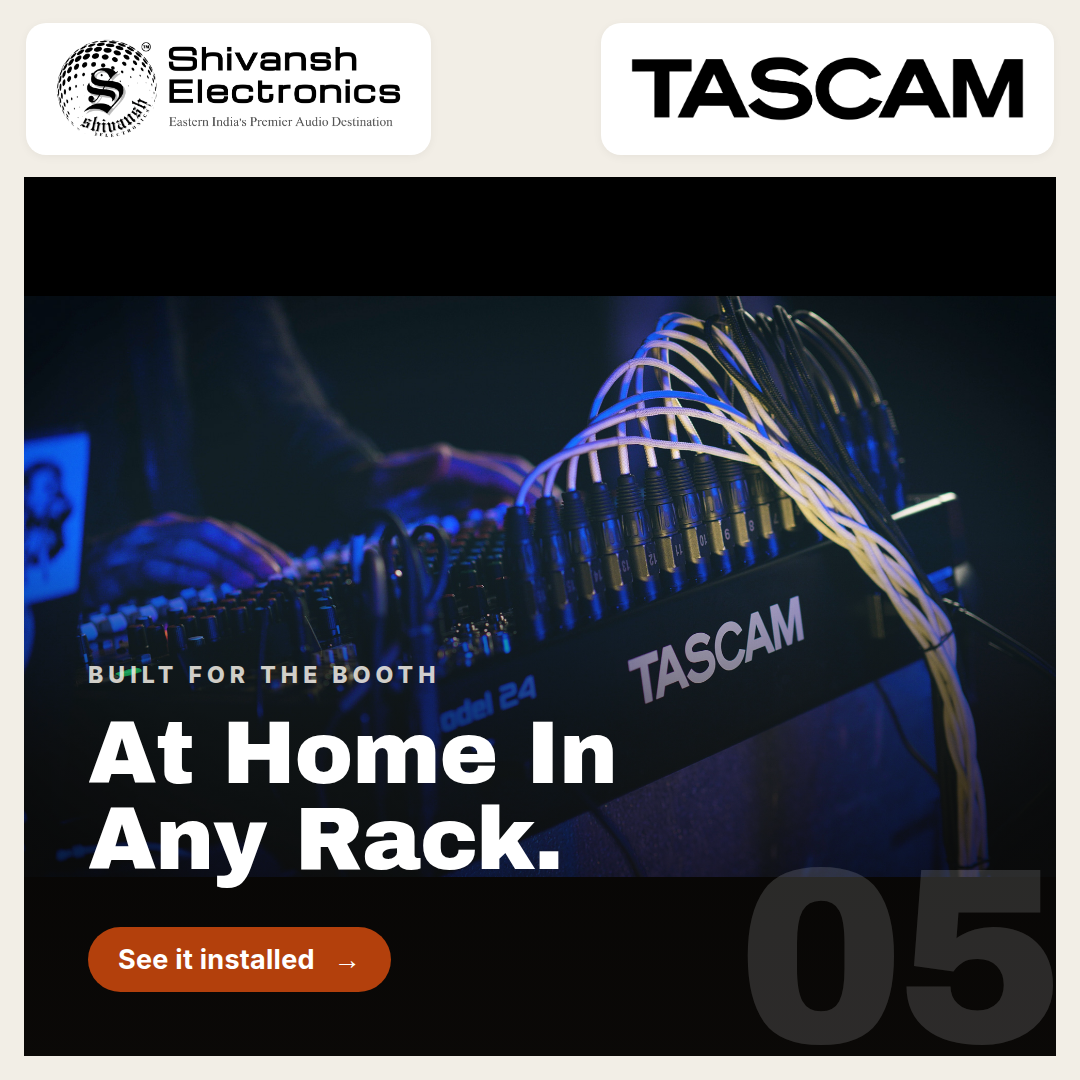
The Model 24 is a large-format desktop console mixer measuring 576 mm (W) × 112.5 mm (H) × 513 mm (D) and weighing 10.2 kg (22.49 lbs) — substantially larger and heavier than the Model 16, reflecting the doubled preamp count, wider fader bank, and additional master-section processing. As a desktop unit rather than a rack-mount design, the Model 24 is intended to sit on a console stand, a dedicated mixing desk, or a stage riser at the mix position, where the operator has direct hands-on access to all 100mm faders and channel controls simultaneously — the defining ergonomic advantage of a large-format tactile mixer over a rack-mounted interface controlled purely through software.
The physical scale of the Model 24 is a direct function of its channel count: 16 Ultra HDDA microphone preamps, 22 total analogue inputs, 100mm faders across the channel strips, a 3-band sweepable EQ on the first 12 channels, one-knob compressors on select inputs, and a dedicated 7-band graphic EQ on the master output all require physical panel space that a compact interface cannot provide. This is the trade-off the Model 24 is built around: it sacrifices portability and desktop footprint in exchange for simultaneous tactile access to every channel — a design priority for live sound engineers and studio operators who need to make rapid, simultaneous adjustments across many channels during a performance or tracking session, rather than navigating a software mixer one channel at a time.
3. MICROPHONE PREAMPS & ANALOGUE INPUT ARCHITECTURE
At the heart of the Model 24 sit 16 TASCAM Ultra HDDA microphone preamps — the same discrete, low-noise preamp architecture used across the professional TASCAM Model series, scaled here to its highest channel count within the standard tier. Each preamp offers a 50 dB adjustable gain range, a maximum input level of +10 dBu, and a minimum input level of -58 dBu, giving the operator a wide practical window for gain-staging everything from quiet ambient microphones to hot, close-miked sources. Input impedance on the microphone path is 1.8 kΩ, a specification consistent with the Model 16's preamp architecture and appropriate for a wide range of dynamic and condenser microphones. All 16 mic inputs are on XLR connectors with +48V phantom power, switchable as needed for condenser microphones while dynamic and ribbon microphones on other channels remain unaffected.
Beyond the 16 XLR microphone inputs, the Model 24's total analogue input count reaches 22 channels: 12 monaural inputs, 4 stereo-paired inputs, and a dedicated stereo auxiliary input accommodating both Bluetooth wireless streaming and unbalanced RCA connections. This configuration is deliberately built for the realities of large-ensemble mixing — the monaural channels absorb the bulk of the individually-miked sources (drums, horns, vocals, instrument DIs), while the stereo-paired channels are purpose-built for stereo keyboard rigs, stereo room microphone pairs, stereo playback sources, or any other paired signal that should move together on a single fader rather than being split across two independent monaural strips. Insert points on channels 1 and 2 (balanced TRS send/return) allow an outboard compressor, gate, or equaliser to be patched directly into the analogue signal path on the two channels most likely to need dedicated outboard processing — typically the lead vocal or a featured instrument.
4. ONBOARD DSP, CHANNEL PROCESSING & MASTER-BUS EQ
The Model 24's signal processing is built around a channel-strip architecture that mixes classic analogue tone-shaping with selective digital signal processing on the master output. The first 12 channels each include a 100 kHz low-cut filter — engaged to remove sub-sonic rumble, stage vibration, HVAC noise, and microphone handling noise before it reaches the mix bus — paired with a 3-band sweepable EQ, giving the operator surgical control over the frequency content of the console's highest-priority individually-miked channels. This channel-level low-cut and EQ combination is a standard large-format mixing console feature that smaller Model-series consoles either omit or implement in reduced form, and it reflects the Model 24's positioning as a genuine live-sound and tracking mixing desk rather than a compact all-in-one interface.
On the master bus, the Model 24 provides a dedicated 7-band graphic EQ — a tool specifically intended for acoustic room tuning rather than individual-channel tone-shaping. In live sound reinforcement, a graphic EQ on the master output is the standard tool for taming a venue's resonant frequencies (feedback-prone room modes, boomy low-frequency buildup, harsh high-frequency reflections) before the mix ever reaches the audience — a task that per-channel EQ cannot efficiently solve because it must be corrected once, globally, on the summed signal. Sixteen preset digital effects (reverbs and other time-based processing) round out the onboard DSP, available for send-based application to any channel without requiring outboard effects units or additional rack space.
5. AUXILIARY SEND ARCHITECTURE & MONITOR MIXING
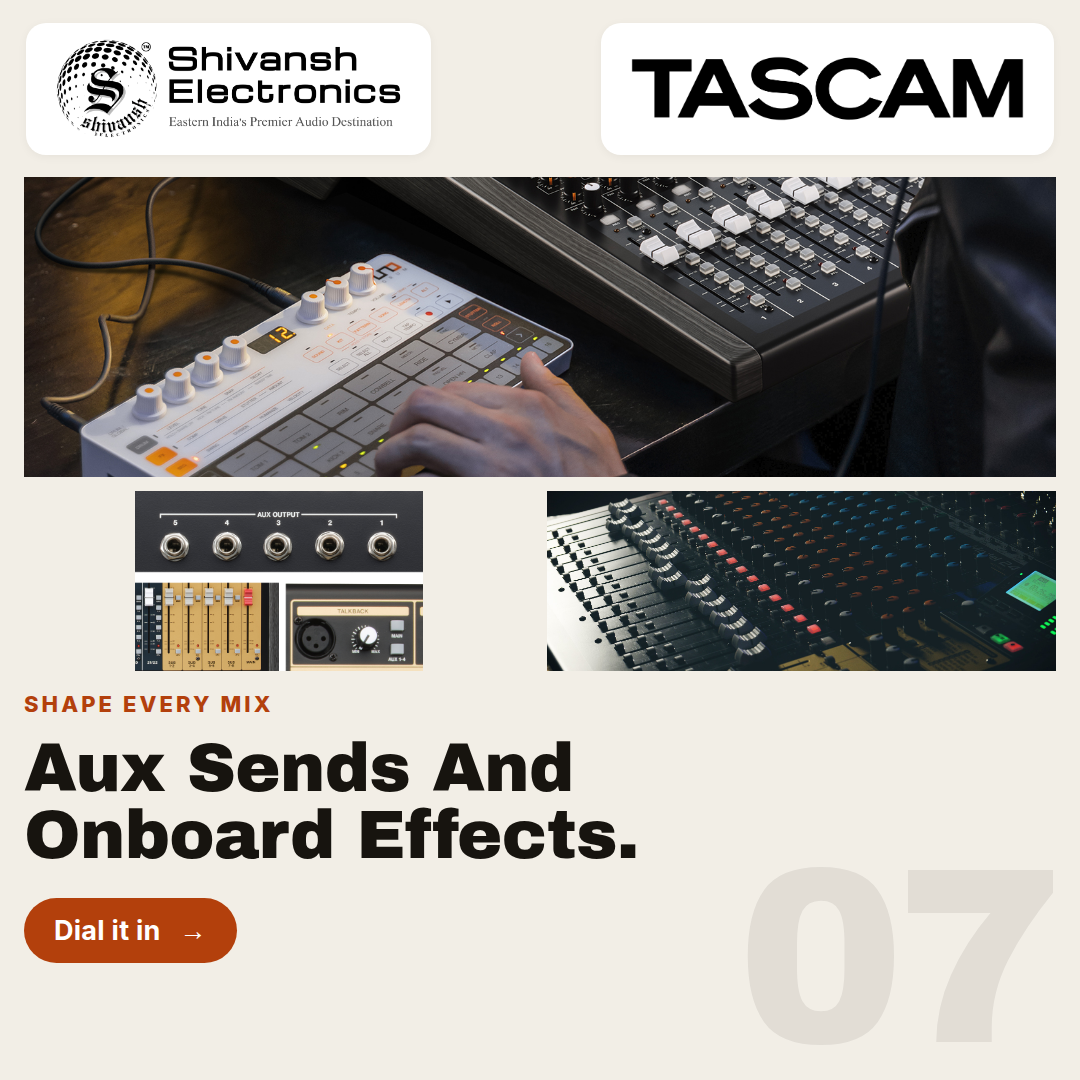
The Model 24 provides three auxiliary sends — Monitor 1, Monitor 2, and FX — giving the front-of-house engineer the routing flexibility to construct two independent stage monitor wedge mixes for performers plus a dedicated external effects loop, all without touching the main house mix. This three-aux architecture is a meaningful step up from smaller consoles in the Model series and reflects a genuine large-ensemble live-sound requirement: a nine- or ten-piece band routinely needs more than a single shared monitor mix, and separating drummer/vocalist wedges from a guitarist/keyboardist wedge — while independently routing reverb or delay sends to an outboard or internal effects unit — is standard professional practice that the Model 24's aux bus count directly supports.
Because each aux send operates pre- or post-fader per channel (standard console routing practice) and each of the 16 preamp channels can be routed into any combination of the three aux buses, the Model 24 supports genuinely independent monitor mixes without requiring a separate monitor console — a meaningful cost and complexity reduction for mid-sized venues and touring productions that cannot justify a dedicated monitor engineer and monitor desk.
6. INTERNAL MULTITRACK RECORDER & SD MEDIA
The Model 24's internal recorder captures 24 simultaneous tracks — calculated as the 22 discrete analogue inputs plus the main left/right stereo mix — directly to SD, SDHC, or SDXC media (supporting cards up to 512GB, Class 10 or faster) at 24-bit/48 kHz resolution. This DAWless recording capability is central to the console's value proposition for live sound engineers: by pressing a single button, the entire ensemble performance is captured as a full multitrack archive, with the mixed stereo programme recorded alongside it in the same pass, entirely independent of any connected computer. For touring and rental applications in particular, this means a reliable multitrack safety recording exists even if the connected laptop crashes, the USB connection drops, or no computer is present at all.
Sample rate on the recorder spans 44.1 kHz and 48 kHz, with bit depth selectable between 16-bit and 24-bit — standard professional recording parameters that balance file size against fidelity depending on the intended use (live multitrack archiving typically favours 24-bit/48 kHz for maximum post-production flexibility). Because the recorder captures all 22 inputs simultaneously alongside the stereo mix, engineers gain the ability to revisit and remix a performance in a DAW after the fact, using the mixed stereo file as a reference while individually processing the raw tracks — a workflow impossible on consoles without full-channel-count simultaneous recording.
7. USB AUDIO INTERFACE & COMPUTER CONNECTIVITY
Beyond its standalone mixing and recording capability, the Model 24 functions as a complete 24-in/22-out USB Audio Class 2.0 interface, transporting the entire analogue channel array directly into a DAW on a connected Mac or PC over Mass-storage/USB Audio Class 2.0 connectivity. This dual-mode operation — simultaneous SD-card multitrack recording and live USB streaming to a DAW — is a defining architectural feature of the Model series: engineers are never forced to choose between DAWless reliability and computer-based recording flexibility, because both capture paths operate concurrently from the same analogue signal chain.
A significant workflow enabled by the USB return path is analogue summing: stems mixed digitally in a DAW can be routed back out of the computer and into the Model 24's analogue channels via the USB returns, allowing engineers to sculpt a final mix using the console's tactile 100mm faders, per-channel EQ, and analogue signal path — injecting analogue headroom and hands-on control into an otherwise fully digital production before printing the summed mix back into the DAW as a stereo file. Because the Model 24 does not include HUI/MCU DAW transport emulation, this USB interface functions purely as an audio transport and analogue-summing path rather than a tactile DAW controller — a distinction that separates it from the Model 12 and the flagship Model 2400, both of which include DAW control alongside their audio interface function.
8. MULTIMEDIA CONNECTIVITY & MONITORING
The Model 24's dedicated stereo auxiliary input accommodates both Bluetooth wireless streaming and unbalanced RCA connections, providing a straightforward path for walk-in music, pre-service playback, or presentation audio to be mixed into the house feed without consuming a channel strip or requiring an additional cable run to the console. This is a practical, everyday feature for house-of-worship and event production environments, where a phone, tablet, or laptop frequently needs to be brought into the mix on short notice.
The console's monitoring path benefits from the same large-format design philosophy applied throughout: the master section provides the controls necessary for a front-of-house engineer to manage the house mix, the three aux sends, and the master 7-band graphic EQ simultaneously from a single ergonomic position, without needing to navigate software menus mid-performance for the console's core mixing functions.
9. MODEL MIXER SETTINGS PANEL & VISUAL METERING
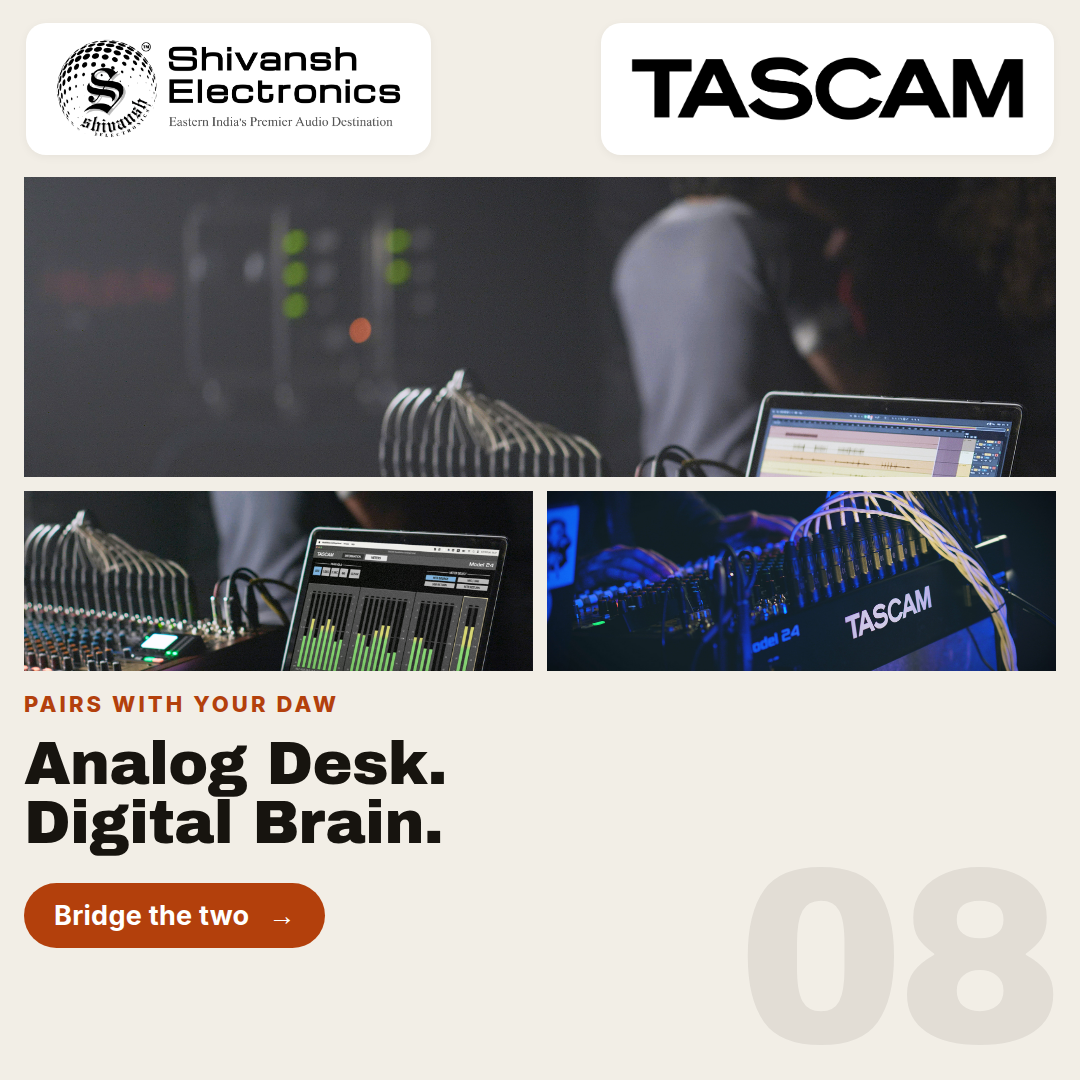
Firmware enhancements to the Model 24 introduced compatibility with the TASCAM Model Mixer Settings Panel application, a software companion that bridges the console's onboard 24-channel signal chain to a connected computer monitor as a scalable, projectable digital meter bridge. This addresses a genuine physical limitation of the Model 24's compact channel-strip design: with 22 analogue channels on a desktop-format console, per-channel dedicated hardware metering for every input is a significant panel-space cost, and the Settings Panel application recovers that visibility by projecting comprehensive peak-hold metering for input, MTR (recorder), or USB signal paths onto any external display.
In practice, this means a commercial studio or touring production can connect a large studio monitor or a stage-side display directly to a laptop running the Settings Panel software, giving the engineer — or anyone else in the room, such as an assistant engineer or a client — a highly visible, real-time overview of signal levels and clipping across all 24 channels simultaneously, without requiring the engineer's eyes to leave the mix position or the console to carry additional dedicated meter hardware.
10. PRODUCT FAMILY CONTEXT — MODEL 24 WITHIN THE TASCAM MODEL SERIES
The TASCAM Model family is a tiered, progressive ecosystem of hybrid analogue/digital consoles that scale linearly in physical footprint, I/O capacity, and professional feature depth. The Model 12 is the compact, highly integrated entry point, unique in the lower tier for HUI/MCU DAW transport emulation, 5-pin MIDI I/O, and Bluetooth 5.0 — an ideal tactile hub for podcasters, solo creators, and electronic music producers, with 8 mic preamps and 12-track SD recording. The Model 16 steps up to 10 mic preamps, 14 analogue inputs, and 16-track SD recording, trading DAW control for a wider analogue footprint, 1-knob compressors, and analogue sweepable EQs suited to small bands and rehearsal spaces.
The Model 24 expands this analogue architecture to its largest standard-tier scale: 16 mic preamps, 22 total inputs, and 24-track SD recording, serving as a massive analogue summing engine and 24-channel USB interface purpose-built for larger bands and live-sound front-of-house deployment. Above it, the Model 2400 retains the Model 24's 24-track architecture and 22-channel analogue layout but critically re-integrates the HUI/MCU DAW control found on the Model 12, adds a fifth aux send, 4 stereo subgroups, and insert points across the first 12 channels — reclassifying it from a live-sound tool into a dedicated commercial studio console. As a buyer moves up the Model range, channel count and preamp availability increase linearly, but DAW control capability skips the middle tier entirely, existing only on the highly integrated Model 12 and the flagship Model 2400 — with the Model 24 positioned deliberately as the pure large-format analogue mixing and multitrack capture solution between them.
TASCAM MODEL SERIES — KEY DIFFERENTIATORS
| FEATURE | MODEL 12 | MODEL 16 | MODEL 24 | MODEL 2400 |
|---|---|---|---|---|
| Mic Preamps (Ultra HDDA) | 8 | 10 | 16 | 16 |
| Total Analogue Inputs | 10 | 14 | 22 | 22 |
| Simultaneous SD Tracks | 12 | 16 | 24 | 24 |
| USB Interface | 12-in/10-out | 16-in/14-out | 24-in/22-out | 24-in/22-out |
| HUI/MCU DAW Control | Yes | No | No | Yes |
| Aux Sends | — | FX bus | 3 (Mon 1, Mon 2, FX) | 5 (4 Aux + FX) |
| Master EQ | — | 4-band sweepable | 7-band graphic | — |
| Stereo Subgroups | — | — | — | 4 |
11. SPECIFICATION CROSS-VALIDATION
11.1 Simultaneous Track Count vs. Analogue Input Count
TASCAM specifies 24 simultaneous recorded tracks against 22 total analogue inputs. The arithmetic is: 22 discrete analogue inputs (12 mono + 4 stereo-paired + 1 dedicated stereo aux, counted as individual channels) plus the main stereo (left/right) mix bus, printed to its own pair of tracks = 24 total tracks captured simultaneously. This is the same calculation pattern used across the entire Model series (Model 12: 10 inputs + 2 mix = 12; Model 16: 14 inputs + 2 mix = 16), and it confirms that the Model 24's 24-track figure is not a discrepancy but the standard Model-series convention of counting the printed stereo mix as two additional simultaneous tracks alongside the raw input tracks. No discrepancy.
11.2 USB Interface Channel Count vs. Analogue I/O
The USB interface is specified as 24-in/22-out. The 24-in figure matches the simultaneous recording track count exactly (22 analogue inputs + stereo mix = 24), meaning the same 24-channel payload available to the internal recorder is also available to a connected DAW over USB. The 22-out figure corresponds to the 22 analogue input channels being available for USB return/summing purposes (rather than including the stereo mix bus as a separate return path, since the mix bus return would create a feedback loop if summed back into itself). This asymmetry between 24 inputs and 22 outputs is consistent and expected given the console's analogue summing workflow, where USB returns feed back into the 22 individual channel strips rather than the master bus. No discrepancy.
11.3 Preamp Gain Range vs. Maximum/Minimum Input Level
The Model 24's preamp specifies a 50 dB adjustable gain range alongside a maximum input level of +10 dBu and a minimum input level of -58 dBu. The difference between the maximum and minimum input levels is +10 − (−58) = 68 dB, which exceeds the specified 50 dB adjustable gain range. This is expected and consistent with standard preamp specification practice: the 50 dB figure describes the adjustable gain control range (how much boost the gain knob itself provides), while the 68 dB spread between max and min input level additionally reflects the preamp's total usable input headroom window at the extremes of that gain range — a wider figure than the gain control alone, because it also accounts for the preamp's noise floor and clipping point at each end of the gain range rather than the control range in isolation. No discrepancy.
12. IDEAL APPLICATIONS & USE CASES
- Large Live Ensemble Front-of-House: 16 mic preamps for a full band with horns, three aux sends for dual monitor wedges plus an FX loop, 7-band graphic EQ for room tuning.
- Commercial Studio Drum and Band Tracking: 16 simultaneous mic inputs for a complex drum kit or full-band session, direct USB feed into Pro Tools or Logic Pro, 100 kHz low-cut filters on the first 12 channels.
- Post-Production Analogue Summing: 22 stems returned from a DAW via USB, summed through the analogue channel strips and 100mm faders, printed back as a finished stereo master.
- House of Worship Live Sound and Streaming: Bluetooth/RCA stereo aux for walk-in music and slides, simultaneous USB feed to OBS for live streaming, internal SD backup recording.
- Institutional Rehearsal and Ensemble Archiving: 24-track SD capture with punch in/out on up to 8 tracks, SDXC media up to 512GB for extended session logging.
- Touring and Rental Production: DAWless multitrack safety recording independent of any connected computer, Model Mixer Settings Panel for visual meter-bridge monitoring on any external display.
- Broadcast and Live Stream Audio Mixing: 24-channel USB feed direct to streaming software, dedicated stereo aux for presenter media playback, master EQ for consistent programme tone.
HOW TO READ THIS DOCUMENT
This document is the operational companion to the TASCAM Model 24 Product Description and Technical Specifications document. Where the Specs document answers "what does the Model 24 do and how is it measured?", this document answers "how do I actually deploy and use the Model 24 in my specific professional environment?" Every workflow section describes a named scenario with physical setup, signal routing, configuration detail, and the specific features of the Model 24 that make that workflow efficient or even possible. Together, the two documents constitute a complete technical and operational reference for the TASCAM Model 24.
Three defining workflow advantages of the TASCAM Model 24 appear repeatedly across the scenarios in this document. First, its 16 Ultra HDDA microphone preamps and 22-channel analogue input array make it the highest-capacity console in the standard Model tier, capable of mic'ing an entire large ensemble in a single pass without leaving any performer or instrument off the board. Second, its 24-track simultaneous SD recording — captured independently of any connected computer — means every performance is safety-recorded as a complete multitrack archive the moment the console is powered on, with the finished stereo mix printed alongside the raw tracks in the same pass. Third, its dual-mode operation as both a standalone analogue console and a 24-in/22-out USB interface means engineers are never forced to choose between DAWless reliability and computer-based recording flexibility — both capture paths run concurrently from the same signal chain.
Each workflow section is structured as follows: a scenario description, a physical and signal-routing walkthrough, a discussion of which Model 24 features are most critical in that environment, and a summary table for use as a practitioner's checklist. Some workflows include multiple sub-scenarios to cover common variations within the same environment. Select the workflows most relevant to your application — not every section will apply to every reader.
WORKFLOW 1 — LARGE LIVE ENSEMBLE FRONT-OF-HOUSE
Scenario A: Nine-Piece Funk Band on a Mid-Sized Venue Stage
A nine-piece funk band books a mid-sized venue for a headline performance, and the house engineer needs a console with enough microphone preamplification to capture the full ensemble without compromise. The drum kit alone occupies 8 microphones (kick in, kick out, snare top, snare bottom, hi-hat, and three overheads), the horn section requires 4 more (trumpet, tenor sax, trombone, and a shared room mic), vocals take 3 (lead and two backing singers), and direct instruments — bass DI, keys DI, and a second guitar DI — consume the remaining inputs. The Model 24's 16 Ultra HDDA microphone preamps absorb this entire array on a single console, with headroom to spare for a support act's smaller setup later in the evening.
The FOH engineer relies on the three auxiliary outputs — Monitor 1, Monitor 2, and FX — to construct the stage monitor and effects architecture the band requires. Monitor 1 feeds a wedge mix for the drummer and bassist (rhythm section players who need to hear each other precisely), Monitor 2 feeds a separate wedge for the horn section and lead vocalist, and the FX bus routes selected channels — primarily vocals and lead instruments — to an external effects loop or the console's own internal effects unit for send-based reverb. This three-way aux split means two genuinely independent stage mixes are achievable without a dedicated monitor engineer or a separate monitor desk, a significant cost saving for a mid-sized venue.
On the master bus, the 7-band graphic EQ is deployed to acoustically tune the PA system to the venue's resonant frequencies — taming a boomy low-mid buildup near the stage, or notching out a feedback-prone frequency in the vocal microphone's proximity to the monitor wedges. By pressing a single button before the band takes the stage, the engineer simultaneously arms all 24 tracks for SD recording, capturing a complete multitrack archive of the performance for post-production mixing — entirely independent of a tethered laptop, which many mid-sized venues do not provide space or power for at the FOH position.
Workflow Summary: Large Ensemble FOH — Nine-Piece Band
| WORKFLOW ELEMENT | DETAILS / CONFIGURATION |
|---|---|
| Drum kit inputs | 8 mic channels (kick in/out, snare top/bottom, hi-hat, 3× overhead) |
| Horn section inputs | 4 mic channels (trumpet, tenor sax, trombone, section room mic) |
| Vocal inputs | 3 mic channels (lead + 2 backing) |
| Direct instrument inputs | Bass DI, keys DI, second guitar DI (analogue line inputs) |
| Aux 1 (Monitor 1) | Drummer / bassist wedge mix |
| Aux 2 (Monitor 2) | Horn section / lead vocalist wedge mix |
| Aux 3 (FX) | Vocal and lead instrument reverb send |
| Master bus processing | 7-band graphic EQ tuned to venue acoustics |
| Multitrack safety recording | 24 tracks to SD card, single-button arm, computer-independent |
| Sample rate | 24-bit / 48 kHz |
Scenario B: Support Act Changeover Without Re-Patching
Later the same evening, a four-piece support act with a simpler setup — drums, bass, guitar, and a single vocal — takes the stage between headline sets. Because the Model 24's 16 preamps were never fully committed to the headline act's setup (only 15 of 16 channels were used), the engineer patches the support act's inputs into the remaining unused channels rather than re-patching the headliner's cabling, preserving the FOH mix settings for the headline band's return set. The three aux sends are reassigned on the fly: Monitor 1 becomes the support act's single shared wedge mix, and Monitor 2 and the FX bus remain available for any last-minute adjustments.
This changeover workflow illustrates a practical advantage of the Model 24's high channel count in a multi-act venue setting: rather than sacrificing preparation time to full re-patching between acts, the engineer works within the console's spare capacity, and the 24-track recorder continues capturing a complete multitrack file for the support act's set — useful both as a soundcheck reference for future bookings and as promotional content for the supporting artist.
WORKFLOW 2 — COMMERCIAL STUDIO DRUM AND BAND TRACKING
Scenario: Complex Drum Kit Tracking with Direct DAW Feed
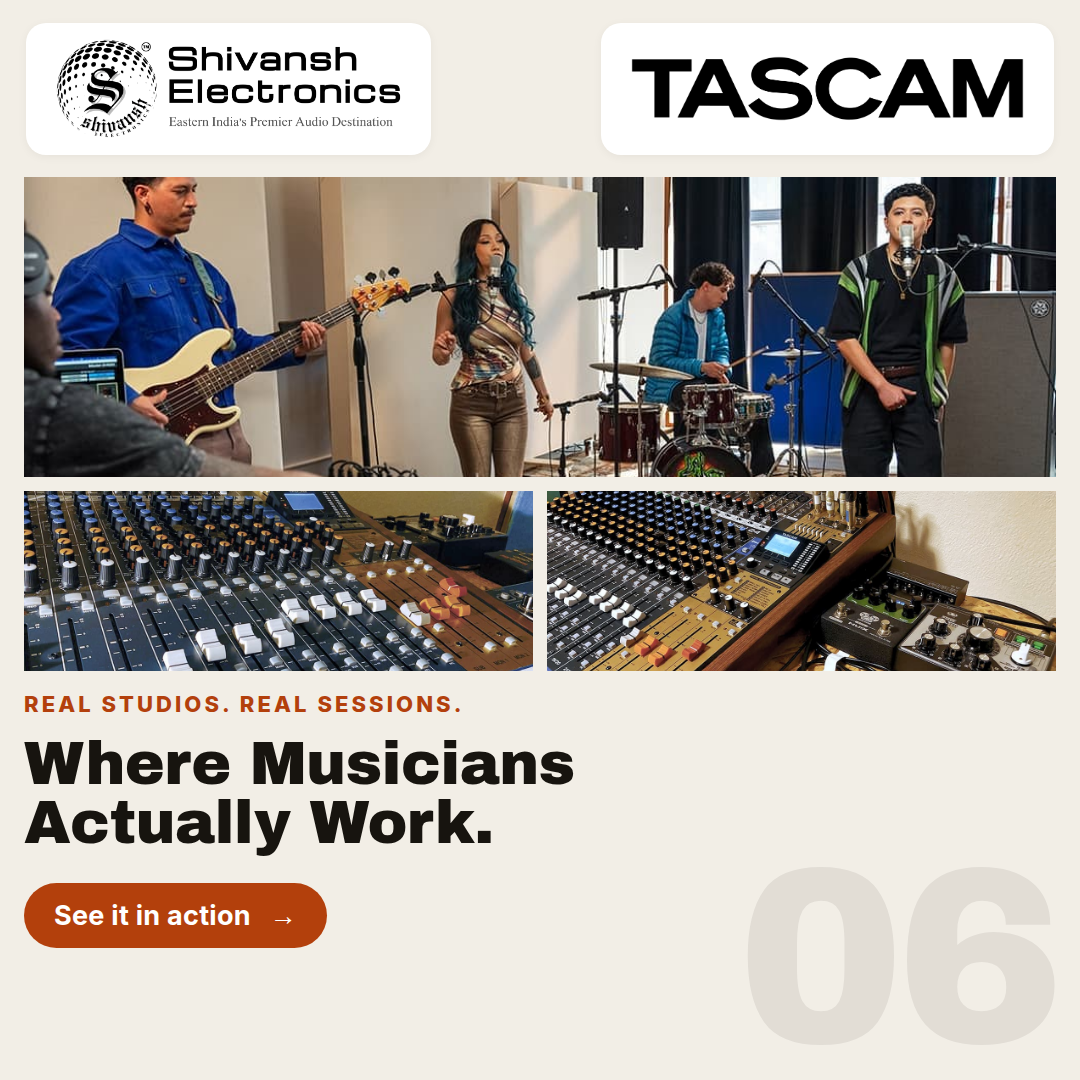
In a dedicated recording facility, a complex drum kit — kick, snare top and bottom, three rack toms, floor tom, hi-hat, a stereo overhead pair, and a pair of room microphones — is tracked using the Model 24 as the primary analogue front-end. The 16 Ultra HDDA preamps capture the full kit directly into Pro Tools via the 24-channel USB connection, with the console's tactile 100mm faders and per-channel gain controls giving the engineer immediate, simultaneous access to every microphone's level during the critical drum-sound-dialing phase of a session, when small adjustments across many channels need to happen quickly while the drummer plays reference patterns.
The engineer leverages the analogue 100 kHz low-cut filters on the first 12 channels to eliminate structural stage rumble and low-frequency mechanical noise from the drum riser before the signal ever reaches the analogue-to-digital converter — a cleaner, more effective approach than attempting to remove the same rumble with a digital high-pass filter after the fact, since the analogue filter prevents the rumble from consuming headroom in the recording chain at all. The console's insert points on channels 1 and 2 are typically assigned to the kick and snare — the two drum channels most likely to benefit from an outboard compressor patched directly into the signal path before conversion.
Throughout the session, the TASCAM Model Mixer Settings Panel application is displayed on a large studio monitor positioned where both the engineer and any visiting producer or artist can see it, providing a highly visible digital meter bridge that shows peak levels across all 24 channels simultaneously — a genuine convenience during a busy tracking day when the engineer's attention is split between the DAW window, the console, and the performers in the live room.
Workflow Summary: Commercial Studio Drum Tracking
| WORKFLOW ELEMENT | DETAILS / CONFIGURATION |
|---|---|
| Drum kit input count | 10 channels (kick, snare top/bottom, 3× toms, floor tom, hi-hat, stereo OH, stereo room) |
| Interface connection to DAW | 24-in/22-out USB Audio Class 2.0 to Pro Tools |
| Low-cut filters | 100 kHz low-cut, channels 1–12, applied to rumble-prone drum mics |
| Insert points (Ch 1–2) | Kick and snare — outboard compressor patched pre-conversion |
| Visual metering | Model Mixer Settings Panel on studio monitor — all 24 channels |
| Simultaneous SD backup | Full session recorded to SD card alongside USB feed to DAW |
| Sample rate | 24-bit / 48 kHz |
| DAW platform | Pro Tools, Logic Pro, or any USB Audio Class 2.0-compatible DAW |
WORKFLOW 3 — POST-PRODUCTION ANALOGUE SUMMING
Scenario: Full-Mix Analogue Summing for a Digitally-Produced Record
A mix engineer finalises a dense digital arrangement — programmed drums, layered synths, sample-based instrumentation, and recorded vocals — entirely within a DAW. To inject analogue warmth and hands-on tactile control into the final mix pass, rather than relying entirely on in-the-box plugin summing, the engineer routes 22 distinct stems out of the computer and into the Model 24's analogue channels via the USB returns. This is the console's analogue summing workflow: because the Model 24 functions as a 24-in/22-out interface, the 22 individual channel returns map directly onto the console's 22 physical analogue channel strips, each with its own gain, EQ, and fader.
The mix is executed manually using the 100mm faders and the 3-band sweepable EQ on the first 12 channels, with the engineer riding levels dynamically in real time exactly as they would during a live mix — a workflow fundamentally different from automating fader moves inside a DAW, because the engineer's hands are on the actual analogue signal path and can react to the summed mix in the room, through the monitors, rather than through a plugin's metering. The console's headroom sums the tracks organically, with the natural non-linearities of analogue circuitry contributing the subtle harmonic complexity that many engineers seek from outboard summing.
Once the mix is balanced to the engineer's satisfaction, the final analogue-summed stereo output is routed back into the DAW as a printed master file — completing a workflow loop where the mix both begins and ends inside the computer, but passes through genuine analogue circuitry at the critical summing stage. Because the Model 24 lacks the HUI/MCU transport control of the Model 2400, this workflow is purely audio-path-based: the engineer operates the DAW's transport controls independently (via mouse, keyboard, or a separate control surface) while using the Model 24 exclusively for its analogue summing capability.
Workflow Summary: Post-Production Analogue Summing
| WORKFLOW ELEMENT | DETAILS / CONFIGURATION |
|---|---|
| Stems returned from DAW | Up to 22 individual stems via USB returns |
| Analogue channel mapping | Each USB return mapped to a physical channel strip (fader, EQ, gain) |
| Tone-shaping tools | 100mm faders + 3-band sweepable EQ (channels 1–12) |
| Master bus tone control | 7-band graphic EQ on final summed output |
| Final output routing | Summed stereo mix printed back into DAW as master file |
| DAW transport control | Operated independently (no HUI/MCU on Model 24) |
| Sample rate | 44.1 or 48 kHz, matching session rate |
WORKFLOW 4 — HOUSE OF WORSHIP LIVE SOUND AND STREAMING
Scenario: Sunday Service with Live Band, Walk-In Media, and Broadcast Stream
A large house of worship deploys the Model 24 as its front-of-house console for Sunday services, where the praise band's physical inputs occupy the majority of the 16 mic preamps and analogue line inputs — vocals, acoustic and electric guitars, bass DI, keys, and a full drum kit. Separately, the pastor's walk-in music and any pre-service or sermon-support media is triggered via a mobile device or tablet connected through the console's dedicated stereo auxiliary input, which accommodates both Bluetooth wireless streaming and unbalanced RCA connections — meaning no additional channel strip or physical cable run is required to bring last-minute media content into the house mix.
Because the console functions simultaneously as a 24-in USB interface and a standalone analogue mixer, the live audio is piped directly into OBS Studio (or comparable streaming software) on the church's broadcasting computer for the live stream reaching remote congregants, while the internal SD recorder captures the identical signal chain as a computer-independent failsafe backup. This dual-path capture means that if the streaming computer experiences any failure — a dropped internet connection, a software crash, an accidental disconnection — the service audio is never lost, because the SD card recording continues uninterrupted on the console itself.
The master 7-band graphic EQ is tuned once, typically during a Saturday sound check, to compensate for the sanctuary's specific acoustic characteristics — a common requirement in worship spaces, which are frequently designed with visual and architectural priorities that create acoustically challenging environments (high ceilings, hard reflective surfaces, long reverb times). Once tuned, the graphic EQ setting typically remains stable from week to week, requiring only minor adjustment as the room's occupancy or seasonal humidity changes the acoustic response.
Workflow Summary: House of Worship Production
| WORKFLOW ELEMENT | DETAILS / CONFIGURATION |
|---|---|
| Praise band inputs | Vocals, acoustic/electric guitar, bass DI, keys, full drum kit |
| Walk-in media / sermon support | Bluetooth or RCA into dedicated stereo aux input |
| Live stream output | 24-in USB feed direct to OBS Studio / Wirecast / vMix |
| Failsafe backup recording | Simultaneous 24-track SD recording, independent of streaming computer |
| Master bus tuning | 7-band graphic EQ, tuned to sanctuary acoustics during sound check |
| Aux sends | Monitor 1/2 for stage wedges, FX for vocal reverb |
| Sample rate | 48 kHz |
WORKFLOW 5 — INSTITUTIONAL REHEARSAL ARCHIVING
Scenario: Music Conservatory Ensemble Rehearsal Space
A music conservatory installs the Model 24 in its primary large-ensemble rehearsal space, where student groups — jazz combos, chamber ensembles, contemporary bands — plug into the board to monitor their own practices and record sessions for review. The instructor uses the SD recorder to capture overdubs and full-ensemble takes, utilising the console's ability to punch in and out on up to 8 tracks simultaneously — a feature that allows a specific section of a performance (a difficult passage, a single instrument's part) to be re-recorded without disturbing the surrounding, already-approved material on the other tracks.
Because SDXC media supports cards up to 512GB, the conservatory can log an entire term's worth of rehearsal sessions without needing to constantly manage storage or transfer files between sessions — a meaningful administrative simplification for a facility where student turnover and varying technical proficiency make consistent file-management discipline difficult to enforce. At the end of each session, or at the end of a teaching week, staff export the resulting WAV files from the SDXC card for instructor review, giving faculty the ability to evaluate student progress against prior recordings without needing to be physically present at every rehearsal.
The console's 16 mic preamps and 22 analogue inputs comfortably exceed the input requirements of nearly any student ensemble likely to use the space — a chamber quartet, a ten-piece jazz big band section, or a small contemporary rock group — meaning the same console configuration serves the full range of academic ensembles without requiring reconfiguration between bookings, a practical necessity in a shared institutional facility with a tightly scheduled rehearsal calendar.
Workflow Summary: Conservatory Rehearsal Archiving
| WORKFLOW ELEMENT | DETAILS / CONFIGURATION |
|---|---|
| Typical ensemble sizes served | Chamber quartets through 10-piece jazz/rock ensembles |
| Punch in/out capability | Up to 8 tracks simultaneously |
| Storage media | SDXC up to 512GB — full-term session logging |
| File export for review | WAV files exported from SDXC card for instructor evaluation |
| Configuration consistency | Single console setup serves full range of student ensembles |
| Sample rate | 24-bit / 48 kHz |
WORKFLOW 6 — TOURING AND RENTAL PRODUCTION
Scenario: Multi-Venue Tour with Nightly Backline and Console Changeover
A touring production company supplies front-of-house mixing for a mid-level touring act playing a different venue every night across a multi-week run. Reliability independent of any single point of failure is the primary design requirement for this kind of deployment: the touring engineer cannot depend on a venue's house computer, a stable internet connection, or a laptop that survives a month of daily transport in a road case. The Model 24's DAWless 24-track SD recording capability means every night's performance is captured as a complete multitrack archive the moment the console is powered on and armed, with no computer connection required at all.
At each new venue, the touring engineer's setup routine benefits directly from the console's channel capacity: because 16 preamps and 22 total inputs comfortably exceed the touring act's typical input list, the same channel patch list travels with the tour regardless of the specific mix of house backline and touring gear encountered at each venue — a meaningful time saving during load-in and sound check, when the crew's available setup window is often compressed to under an hour. When a computer is available at a given venue (for archiving, virtual sound check, or a house streaming feed), the console's 24-in/22-out USB connection provides that path as a secondary, non-essential capability rather than a dependency.
The TASCAM Model Mixer Settings Panel application, when a laptop is present, gives the touring engineer a familiar visual reference across venues with wildly different house lighting conditions and sight lines to the physical console — a projected meter bridge on a laptop screen remains legible and consistent even in venues where stage lighting or ambient conditions make reading physical console LEDs difficult from the mix position.
Workflow Summary: Touring and Rental Production
| WORKFLOW ELEMENT | DETAILS / CONFIGURATION |
|---|---|
| Nightly recording reliability | 24-track SD recording, no computer dependency |
| Standardised patch list | 16 preamps / 22 inputs cover typical touring act input list at every venue |
| Load-in time savings | Same patch configuration regardless of house backline mix |
| Optional computer connection | 24-in/22-out USB — secondary, non-essential capability |
| Visual metering across venues | Model Mixer Settings Panel — consistent regardless of house lighting |
| Storage media | SDXC — multi-week tour archive without frequent card changes |
| Sample rate | 24-bit / 48 kHz |
WORKFLOW 7 — BROADCAST AND LIVE STREAM AUDIO MIXING
Scenario: Multi-Presenter Panel Broadcast with Media Playback
A production company mixes audio for a multi-presenter panel broadcast — several hosts and guests on stage microphones, plus scheduled video and audio clip playback integrated into the live programme. The Model 24's 16 mic preamps comfortably cover a panel of presenters and guests (typically 6–10 individual microphones for a panel discussion format), while the dedicated stereo auxiliary input handles pre-produced media playback via Bluetooth from a producer's tablet or laptop, routed into the house mix at the precise moment a video package or audio clip needs to play.
The 24-channel USB feed connects directly to the broadcast production computer running the streaming or broadcast software, giving the technical director a complete, individually-adjustable channel array for live mix decisions — muting a guest's microphone during a technical pause, riding a host's level when they lean closer to the microphone, or quickly bringing up a clip's playback level relative to the panel discussion. Because all 24 channels transport over the single USB connection, the broadcast computer's software mixer (if used in addition to the console) has access to the full unmixed channel array for more granular post-production adjustment if the broadcast is also being recorded for later editing.
The master EQ ensures consistent programme tone across the full broadcast — a particular concern in panel-format programming, where microphone technique varies significantly between presenters (some sit close to the mic, others gesture and move, some project loudly while others speak softly), and a consistent master-bus tone helps unify these variations into a professional-sounding final mix for the audience.
Workflow Summary: Broadcast and Live Stream Mixing
| WORKFLOW ELEMENT | DETAILS / CONFIGURATION |
|---|---|
| Panel presenter inputs | 6–10 mic channels for hosts and guests |
| Media playback | Bluetooth into dedicated stereo aux input |
| Broadcast computer feed | Full 24-channel USB connection to production/streaming software |
| Live mix control | Per-channel mute/level riding from 100mm faders during broadcast |
| Programme tone consistency | Master EQ unifies varying presenter mic technique |
| Backup recording | Simultaneous 24-track SD capture for post-production editing |
| Sample rate | 48 kHz |
WORKFLOW 8 — THEATRE AND PERFORMING ARTS PRODUCTION
Scenario: Musical Theatre Production with Pit Orchestra and Wireless Cast Mics
A regional theatre company mounts a musical theatre production requiring a pit orchestra of eight to ten musicians plus a cast of wireless-miked performers on stage. The sound designer routes the pit orchestra's individual instrument microphones and DIs into the majority of the Model 24's mic preamps, while the remaining preamps and line inputs accept the outputs from a wireless microphone receiver rack handling the principal cast's headset or lavalier microphones. The console's 22-channel capacity means the full pit-plus-cast input list fits on a single console without requiring channel-sharing compromises between scenes.
Two of the three aux sends handle the production's monitor requirements: Monitor 1 feeds the conductor's in-ear or wedge cue mix (critical for keeping the pit synchronised with the stage action), and Monitor 2 feeds a foldback mix for any on-stage musicians or performers who need to hear the pit orchestra directly. The FX send handles reverb for the vocal cast, calibrated to match the specific acoustic character the production wants for the house — typically a moderate theatrical reverb that supports the vocals without washing out spoken dialogue delivered through the same wireless microphones.
Because musical theatre runs typically span weeks or months of repeated performances, the Model 24's SD recording capability provides an ongoing archive of every performance — useful for the sound designer to review specific nights where a technical issue occurred, for the production to create an archival recording of the run, or for insurance and licensing documentation purposes that many theatrical licensing agreements require.
Workflow Summary: Theatre and Performing Arts
| WORKFLOW ELEMENT | DETAILS / CONFIGURATION |
|---|---|
| Pit orchestra inputs | 8–10 individual instrument mic/DI channels |
| Cast microphone inputs | Wireless receiver rack outputs on remaining preamps/line inputs |
| Aux 1 (Monitor 1) | Conductor cue mix (in-ear or wedge) |
| Aux 2 (Monitor 2) | On-stage foldback for pit orchestra audibility |
| Aux 3 (FX) | Vocal reverb, calibrated to production's house acoustic goal |
| Run-long archiving | 24-track SD recording of every performance across the run |
| Sample rate | 24-bit / 48 kHz |
WORKFLOW 9 — CORPORATE EVENT AND CONFERENCE PRODUCTION
Scenario: Multi-Day Conference with Keynotes, Panels, and Breakout Sessions
An AV production company handles main-stage audio for a multi-day corporate conference featuring keynote speakers, panel discussions, and live Q&A segments with audience microphones. The Model 24's 16 preamps cover the full range of inputs a conference main stage typically requires: lectern and handheld microphones for keynote speakers, multiple panel microphones for discussion segments, and one or more audience/roving microphones for Q&A — all patched simultaneously so the engineer can transition between segment types without re-patching between agenda items.
The dedicated stereo auxiliary input handles the frequent need for a presenter's laptop audio — video clips embedded in a keynote slide deck, a musical sting for a sponsor recognition segment, or pre-recorded video testimonials — routed via Bluetooth or a direct RCA connection from the presentation laptop at front-of-house. Because corporate events frequently record every session for post-event distribution to attendees who could not attend in person, the console's 24-track SD recording captures each day's full programme as individual, clearly separated multitrack files, while the USB connection simultaneously feeds a production computer for any live streaming component of the event.
Between conference days, the sound engineer's setup remains largely unchanged — a significant advantage for a multi-day event where the crew is managing many simultaneous logistical demands (staging changes, lighting adjustments, breakout room support) and cannot afford to spend setup time re-configuring the main console from scratch each morning.
Workflow Summary: Corporate Event and Conference Production
| WORKFLOW ELEMENT | DETAILS / CONFIGURATION |
|---|---|
| Speaker/panel/audience inputs | Lectern, handheld, panel, and roving mics across 16 preamps |
| Presentation media playback | Bluetooth or RCA into dedicated stereo aux input |
| Daily session recording | 24-track SD, separated files per conference day |
| Streaming feed | 24-in USB to production/streaming computer |
| Multi-day consistency | Console configuration unchanged between conference days |
| Sample rate | 48 kHz |
WORKFLOW 10 — MULTI-CAMERA VIDEO PRODUCTION AUDIO
Scenario: Live Concert Video Shoot with Multitrack Audio Capture
A video production crew films a live concert for a multi-camera video release, working alongside the venue's front-of-house engineer to capture a clean multitrack audio feed synchronised to the video footage. The Model 24 is deployed as a dedicated audio-capture console separate from the house mixing desk, receiving parallel outputs (via splitter or a shared stage box) from the same microphones feeding the house PA. This parallel-feed arrangement means the video production's audio capture is entirely independent of the house engineer's live mixing decisions — a critical requirement for post-production, where the video mix engineer needs raw, unprocessed multitrack stems rather than a printed house mix.
The 24-track SD recording captures the full band's individual channels alongside a reference stereo mix, giving the post-production audio team both the flexibility of individual stems for detailed remixing and a quick-reference stereo file for rough-cut editing before the final audio mix is complete. Because the console operates entirely independently of the house system, any house-side technical issues (a blown amplifier, a feedback incident, a house engineer's mixing choice that doesn't suit the video release) have no impact on the integrity of the video production's captured audio.
Timecode synchronisation between the audio capture and the multi-camera video system is typically handled through a shared clap-slate reference at the start of recording, or through a dedicated timecode generator feeding both systems — a standard practice in multi-camera live-event video production that the Model 24 supports simply by beginning its SD recording at the same moment the video cameras begin rolling.
Workflow Summary: Multi-Camera Video Production Audio
| WORKFLOW ELEMENT | DETAILS / CONFIGURATION |
|---|---|
| Signal source | Parallel splitter feed from same mics as house PA |
| Independence from house mix | Dedicated console, unaffected by house engineer's live decisions |
| Captured content | 22 individual stems + stereo reference mix (24 tracks total) |
| Post-production use | Individual stems for remix; stereo file for rough-cut reference |
| Sync method | Shared clap-slate or timecode generator with video cameras |
| Sample rate | 24-bit / 48 kHz |
WORKFLOW 11 — REHEARSAL FACILITY SHARED BOOKING
Scenario: Commercial Rehearsal Studio Serving Multiple Bands Per Day
A commercial rehearsal facility installs the Model 24 in its largest room, booked by multiple different bands throughout a single day — a metal band in the morning, a jazz ensemble in the afternoon, and a corporate event's live band rehearsing in the evening. The console's 16 preamps and 22 total inputs are sized to comfortably exceed the requirements of nearly any booking the room is likely to receive, meaning the facility's booking staff never need to turn away a client or move them to a different room based on input-count limitations.
Because each booking typically wants a recording of their session — for self-review, for demo purposes, or simply as a record of the rehearsal — the facility's operators arm the 24-track SD recorder at the start of each booking block and hand the client an SD card (or a copied set of WAV files) at the end of their session. The facility's staff, who may not be trained audio engineers, benefit from the console's straightforward single-button record arming and the TASCAM Model Mixer Settings Panel's visual confirmation that all channels are recording correctly — reducing the likelihood of a client leaving with a failed or incomplete recording due to operator error.
Between bookings, the facility's changeover process is simplified by the console's high spare capacity: rather than needing to completely reconfigure input assignments for every new booking, staff typically only need to adjust gain levels and mute unused channels, since the physical patching rarely needs to change across the range of ensemble sizes the room typically hosts.
Workflow Summary: Rehearsal Facility Shared Booking
| WORKFLOW ELEMENT | DETAILS / CONFIGURATION |
|---|---|
| Booking types served | Metal bands, jazz ensembles, corporate rehearsal bands — single day |
| Per-booking recording | 24-track SD arm at session start; client receives WAV files |
| Non-engineer operator support | Single-button record arm + visual confirmation via Settings Panel |
| Changeover between bookings | Gain/mute adjustment only — physical patching rarely changes |
| Storage media | SDXC — multiple daily sessions without frequent card swaps |
| Sample rate | 24-bit / 48 kHz |