


Brand: TASCAM
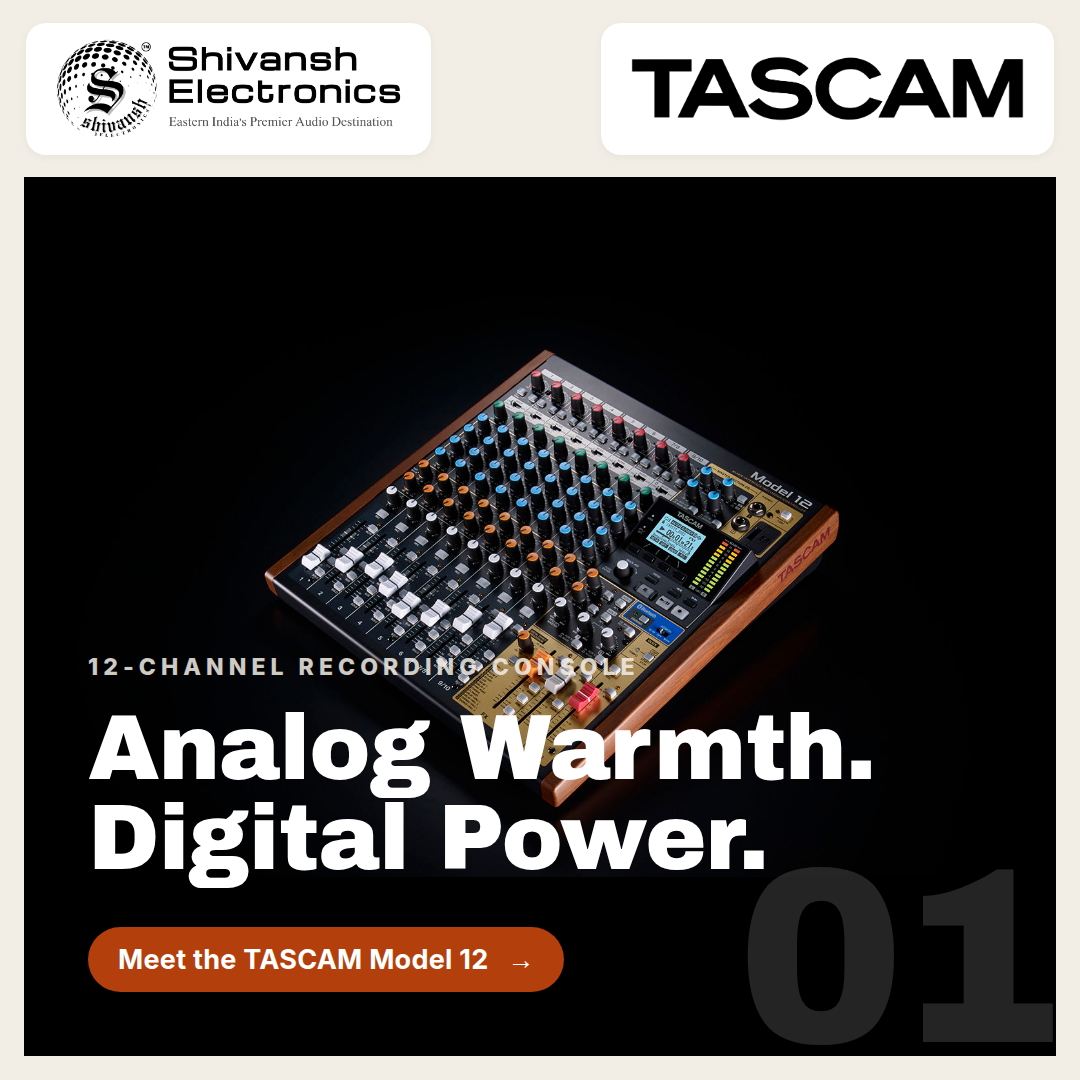
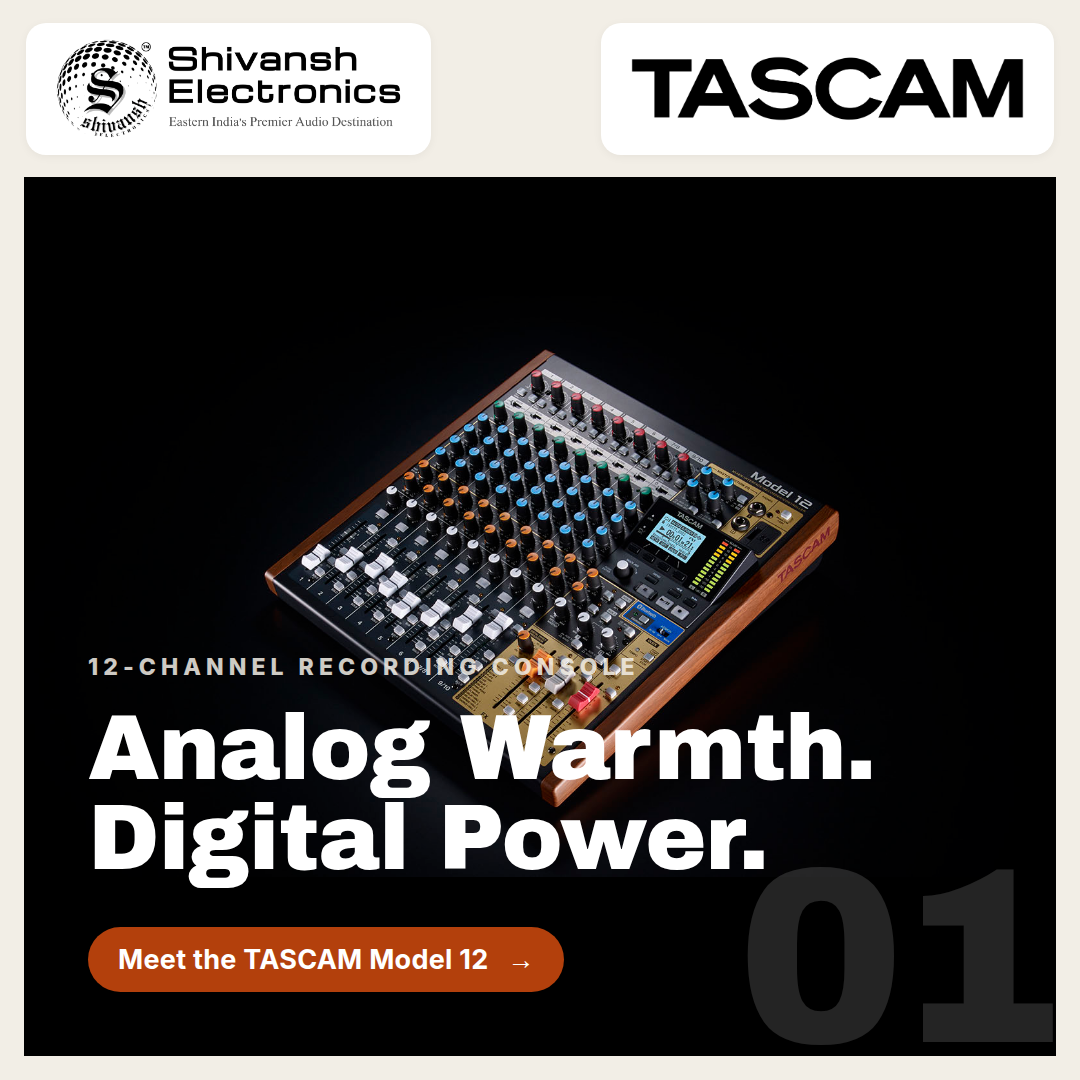
TASCAM MODEL 12
Category: Recording Mixers
12-input mixer with USB interface for DAW integration, precision EQ, and +48V phantom power — built for podcasting, music, and live streams alike.
PLEASE NOTE: Kindly contact us at +91 98316 62458 / +91 91477 00677 to confirm current availability and the best possible pricing (including any additional discount we may be able to offer) before making any payment.
GENERAL
| SPECIFICATION | DETAILS |
|---|---|
| Product Name | TASCAM Model 12 |
| Manufacturer | TEAC Corporation (TASCAM), Tokyo, Japan |
| Product Category | Digital Recording & Mixing Console — 12-Track Multitrack Recorder, Mixer & USB Audio Interface |
| Model Series Position | Entry point of the Model Series (below Model 16, Model 24) |
| Input Channels | 10 (6 mono: Ch 1–6; 2 stereo pairs: Ch 7/8, 9/10) |
| Bit Depth | 16 / 24-bit |
| Sampling Frequency | 44.1 / 48 kHz |
| USB Standard | USB 2.0 High Speed (480 Mbps) |
| USB Connector | USB Type-C |
| USB Format | Mass Storage Class / USB Audio Class 2.0 (class-compliant) |
| Total I/O (USB) | 12 in / 10 out |
| Operating Systems | Windows 11/10 (64-bit), macOS Tahoe/Sequoia/Sonoma, iPadOS 26, iOS 18/17 |
MIC INPUTS (CHANNELS 1–6, 7, 9)
| SPECIFICATION | DETAILS |
|---|---|
| Total Mic Inputs | 8 (Ch 1–6, 7, 9) |
| Preamp Technology | Ultra-HDDA (High Definition Discrete Architecture) |
| Connector | XLR-3-31 (1: GND, 2: HOT, 3: COLD), combo with LINE/INST TRS |
| Maximum Input Level | +10 dBu |
| Nominal Input Level | −8 dBu |
| Minimum Input Level | −58 dBu |
| Gain Adjustment Range | 0 to +50 dB |
| Input Impedance | 1.8 kΩ |
| Input Pad | Not fitted |
| Phantom Power | +48 V, single global switch (all 8 XLR inputs simultaneously) |
| Polarity Invert | Yes, per channel (menu-selectable) |
LINE & INST INPUTS (CHANNELS 1–10)
| SPECIFICATION | DETAILS |
|---|---|
| Total Line Inputs | 10 (Ch 1–10, balanced 1/4" TRS) |
| Total Hi-Z (INST) Inputs | 8 (Ch 1–6, 7, 9 — INST switch, L jack only on stereo pairs) |
| Connector Type | 6.3 mm (1/4") TRS (Tip: HOT, Ring: COLD, Sleeve: GND) |
| Max Input Level (LINE) | +22 dBu |
| Max Input Level (INST) | 19.8 dBV |
| Nominal Input Level | +4 dBu (LINE) / 1.8 dBV (INST) |
| Gain Range (Ch 1–6) | −10 to +40 dB |
| Gain Range (Ch 7/8, 9/10) | −20 to +30 dB |
| Input Impedance (LINE) | 22 kΩ (Ch 1–6) / 18 kΩ (Ch 7,9 / 8,10) |
| Input Impedance (INST) | 1 MΩ |
| Ch 8 / Ch 10 Capability | Balanced LINE only — no XLR, no INST |
INSERT & MUSIC/TALK I/O
| SPECIFICATION | DETAILS |
|---|---|
| INSERT Jacks | Ch 1–2 only, 6.3 mm TRS (Tip: SEND, Ring: RETURN, Sleeve: GND) |
| INSERT Return — Max/Nom Level | +18 dBu / 0 dBu |
| INSERT Return — Impedance | 5 kΩ |
| INSERT Send — Max/Nom Level | +18 dBu / 0 dBu |
| INSERT Send — Impedance | 100 Ω |
| MUSIC/TALK Connector | 3.5 mm (1/8") 4-pole (TRRS) mini jack, Ch 9/10 |
| MUSIC/TALK — Max/Nom Level | +8 dBV / −10 dBV |
| MUSIC/TALK — Impedance | 10 kΩ |
| MUSIC/TALK Behaviour | Bidirectional; disables Ch 9/10 MIC/LINE jacks when connected; automatic mix-minus |
OUTPUTS (MAIN, SUB, AUX, PHONES)
| SPECIFICATION | DETAILS |
|---|---|
| MAIN OUTPUT Connector | XLR-3-32 (1: GND, 2: HOT, 3: COLD), balanced |
| MAIN OUTPUT Level / Impedance | +22 dBu max / +4 dBu nominal / 100 Ω |
| SUB OUTPUT Connector | 6.3 mm TRS, balanced |
| SUB OUTPUT Level / Impedance | +16 dBu max / −2 dBu nominal / 100 Ω |
| AUX OUTPUT 1/2 Connector | 6.3 mm TRS, balanced |
| AUX OUTPUT 1/2 Level / Impedance | +16 dBu max / −2 dBu nominal / 100 Ω |
| PHONES Outputs | 2 (PHONES 1, PHONES 2), 6.3 mm TRS stereo, independent level + routing |
| PHONES Max Output | 45 mW + 45 mW (32 Ω load) |
| PHONES Working Impedance | 16 – 250 Ω |
CHANNEL PROCESSING (EQ, COMPRESSOR, LOW-CUT)
| SPECIFICATION | DETAILS |
|---|---|
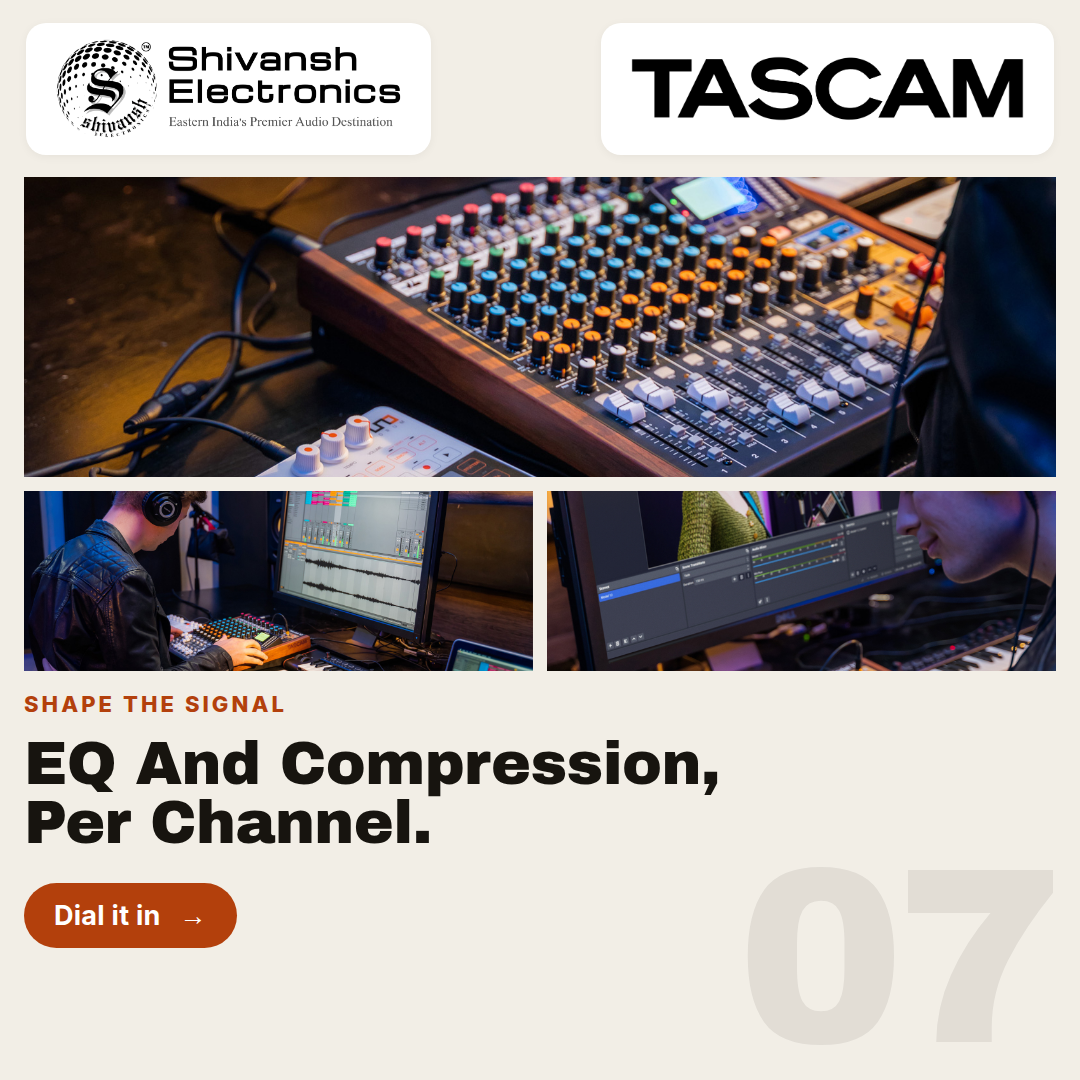
| Compressor | Digital, single-knob (threshold), Ch 1–6, 7/8, 9/10 (10 channels) |
| Low-Cut Filter | 100 Hz, −18 dB/Octave, per-channel switch |
| Channel EQ Type | 3-band semi-parametric, always-on |
| Channel EQ — Hi-Shelving | ±15 dB, cut-off 10 kHz |
| Channel EQ — Mid-Peaking | ±15 dB, 100 Hz–8 kHz variable (default 600 Hz), fixed Q 0.5 |
| Channel EQ — Low-Shelving | ±15 dB, cut-off 80 Hz |
| INST (Hi-Z) Switch | Per channel, Ch 1–6, 7, 9 |
| MODE Switch (source) | LIVE / PC / MTR, per channel |
| Gain Boost Function | DSP-based boost for low-level MIC/LINE sources (from V1.40) |
MASTER SECTION EQ & BUSES
| SPECIFICATION | DETAILS |
|---|---|
| Mix Buses | MAIN MIX L/R, SUB L/R, AUX 1, AUX 2/FX, SOLO L/R |
| Master EQ — Hi-Shelving | ±15 dB, cut-off 10 kHz |
| Master EQ — Mid-Peaking | ±15 dB, 100 Hz–8 kHz variable, switchable narrow/broad Q |
| Master EQ — Low-Shelving | ±15 dB, cut-off 60 Hz |
| Master EQ Assignment | MAIN MIX or AUX 1/2 (switchable, not simultaneous); EQ IN/BYPASS switch |
| AUX 1 Pre/Post | Global switch (shared POST indicator, all channels) |
| AUX 2/FX Pre/Post | Fixed post-fader; shared with internal effects send |
| SOLO Mode | PFL (pre-fade listen) or SIP (solo-in-place) |
| POST REC Switch | Sets MAIN MIX recording/USB tap point pre- or post-MAIN fader |
| Channel Fader Throw | 60 mm |
| Output Pad Function | Adjustable output attenuation, menu-configurable |
BUILT-IN EFFECTS
| SPECIFICATION | DETAILS |
|---|---|
| Effect Count | 16 presets, single shared processor |
| Effect Types | Hall 1/2, Room 1/2, Plate, Studio, Live, Delay 1/2, Ping Pong, Chorus, Flanger, Delay+Hall 1/2, Chorus+Hall 1/2 |
| Send Bus | AUX 2/FX (per-channel knob, post-fader) |
| Return Routing | FX fader + TO AUX1 knob → MAIN, SOLO, AUX1, SUB |
| Preset Storage | Library slots (type + parameters) |
| Delay Tap Tempo | CLICK button, on EFFECT screen |
CONTROL I/O (USB, MIDI, FOOTSWITCH, CLICK)
| SPECIFICATION | DETAILS |
|---|---|
| USB Port | USB Type-C, USB 2.0 High Speed |
| MIDI IN / OUT | 5-pin DIN ×1 each, standard MIDI |
| MIDI Time Code / Clock | 30 fps non-drop MTC + Clock/SPP, via DIN and USB simultaneously (output only) |
| DAW Control Ports | Dedicated USB-MIDI DAW Control IN/OUT, separate from MIDI DIN |
| DAW Protocols | HUI (Pro Tools), Mackie Control / MCU (all other confirmed DAWs) |
| CLICK Jack | 6.3 mm TS, metronome click output |
| FOOTSWITCH Jack | 6.3 mm TRS (dual, unlatched/momentary), TASCAM RC-1F compatible |
| Footswitch Functions | Play/pause, effect mute, punch in/out, tap tempo |
BLUETOOTH®
| SPECIFICATION | DETAILS |
|---|---|
| Version | 5.0 |
| Frequency Band | 2400 – 2480 MHz |
| Output Class / Power | Class 2, <2.5 mW |
| Transmission Range | ≈10 m / 33 ft, unobstructed (estimate) |
| Supported Profile | A2DP |
| Supported Codecs | SBC, AAC (auto-selected) |
| Content Protection | SCMS-T |
| Routing | ASSIGN switch: Channel 9/10 or directly to MAIN |
STANDALONE RECORDER (SD)
| SPECIFICATION | DETAILS |
|---|---|
| Supported Media | SD 512 MB–2 GB, SDHC 4–32 GB, SDXC 64–512 GB (Class 10+) |
| File System | SD: FAT16 · SDHC: FAT32 · SDXC: exFAT |
| Recording / Playback Format | WAV (BWF), 44.1/48 kHz, 16/24-bit |
| Max File Size | 2 GB per track file |
| Max Recordable Channels | 12 (10 ch + 2 stereo mix) |
| Max Song Length | 23:59:59 |
| Max Songs Per Card | 100 |
| Punch In/Out | Manual + automatic (pre-roll, rehearsal mode) |
| Metronome | 20–250 BPM, adjustable time signature/click sound/count-in |
| VAMP Playback | Up to 10 loop point pairs per song, manual/automatic (from V1.11) |
| Output Delay | 0–2,000 ms, 1 ms steps, USB output only (from V1.20) |
| Normalize Function | 0 to −20 dB target range (from V1.41) |
| Overdub Model | Linear per track; TRACK SWAP for multi-take workflow (no same-track comping) |
| Cross-Model Compatibility | Songs load on Model 16 / Model 24 with automatic track re-mapping |
AUDIO PERFORMANCE
| SPECIFICATION | DETAILS |
|---|---|
| Frequency Response | 20 Hz–20 kHz, +0.3/−0.7 dB (MIC IN → MAIN OUT, ref. 1 kHz) |
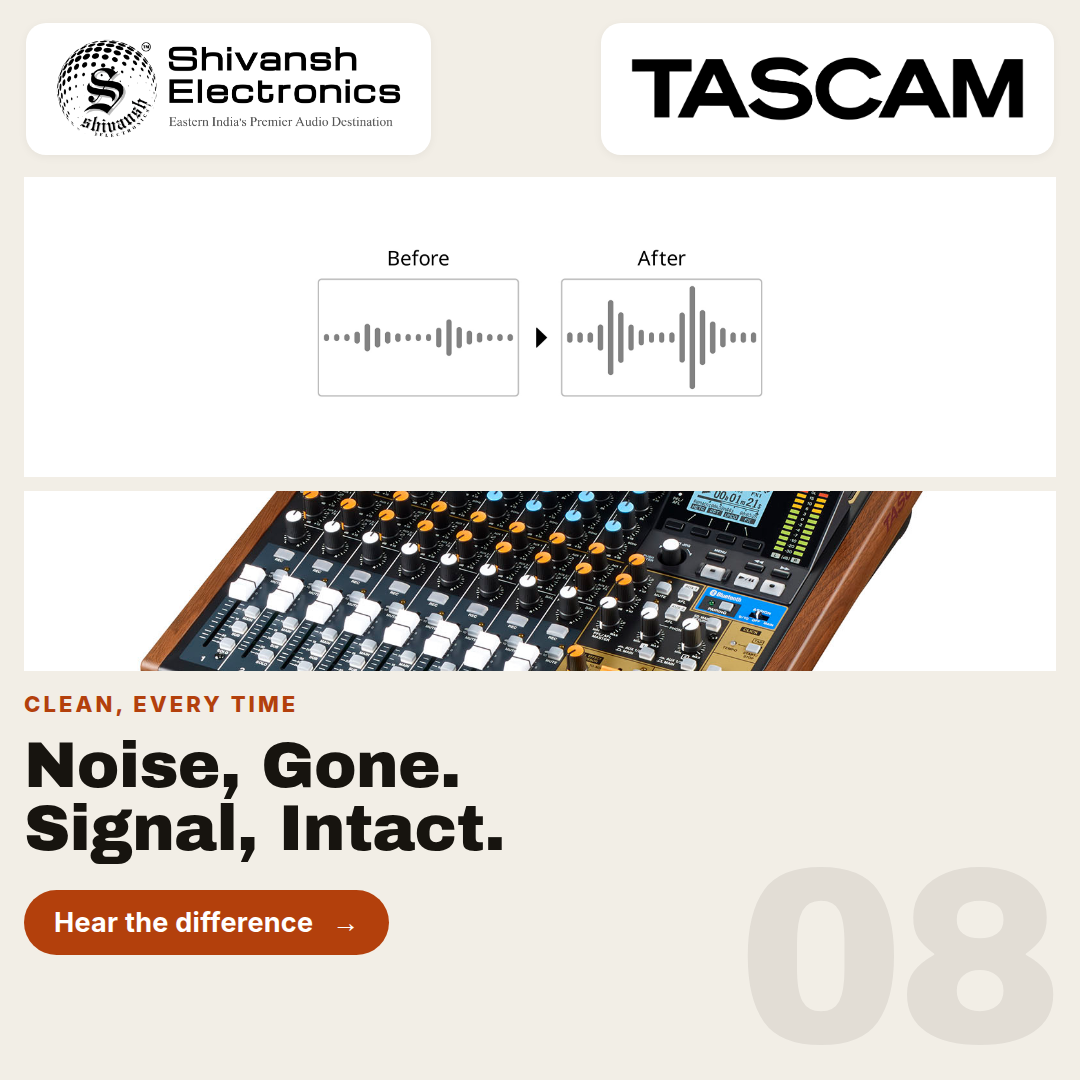
| S/N Ratio | 103 dB (MAIN MIX, Ch.1 @ 0 dB, 22 kHz, A-weighted) |
| Equivalent Input Noise (EIN) | −128 dBu (Rs=150Ω, MIC IN→INSERT SEND, gain MAX, A-weighted) |
| Total Harmonic Distortion (THD+N) | 0.003% (MONO MIC IN→MAIN OUT, +2 dBu, 1 kHz, gain MIN) |
| Crosstalk | −95 dB (channel-to-channel and input-to-output, 1 kHz, PAN hard L/R) |
| Max Gain — MIC→MAIN OUT | 74 dB |
| Max Gain — MIC→INSERT OUT | 54 dB |
| Max Gain — MIC→SUB OUT | 74 dB |
| Max Gain — MIC→AUX OUT | 75 dB |
| Max Gain — USB/SD→MAIN OUT | 24 dB |
COMPUTER SYSTEM REQUIREMENTS
| SPECIFICATION | DETAILS |
|---|---|
| Windows OS | Windows 11, Windows 10 (64-bit); ARM64 not guaranteed |
| Windows CPU / RAM | 2 GHz+ dual-core (x86) / 2 GB+ RAM |
| Windows Driver | TASCAM driver — ASIO 2.0, WDM |
| Mac OS | macOS Tahoe, Sequoia, Sonoma (current); broader legacy support to 10.13 |
| Mac CPU / RAM | 2 GHz+ dual-core / 2 GB+ RAM (Intel & Apple Silicon M1/M2 verified) |
| Mac Driver | Core Audio (native) |
| iOS/iPadOS | iPadOS 26, iOS 18, iOS 17 (current); Core Audio driver |
| iOS Connector Requirement | Lightning devices: genuine Apple Camera Adapter required; USB-C devices connect directly |
| Display | 1280 × 800 or higher (for Settings Panel software) |
PHYSICAL & POWER
| SPECIFICATION | DETAILS |
|---|---|
| Dimensions (incl. side panels) | 343.0 × 98.8 × 360.0 mm / 13.5 × 3.9 × 14.2 in (W×H×D) |
| Dimensions (excl. side panels) | 315.0 × 98.8 × 360.0 mm (W×H×D) |
| Weight | 4.3 kg / 9.48 lb |
| Power Supply | Dedicated external AC adapter (TASCAM PS-M1524/PS-M1524A) |
| Mains Input | AC 100–240 V, 50/60 Hz (universal) |
| Adapter DC Output | DC 15 V, 2.4 A |
| Power Consumption | 16 W |
| Operating Temperature | 5 – 35 °C / 41 – 95 °F |
| Included Items | AC adapter (PS-M1524), AC power cord, USB cable (1m), TRRS cable (1m), Owner's Manual, TASCAM ID guide |
| Optional Carrying Bag | CS-Model12 |
1. PRODUCT OVERVIEW
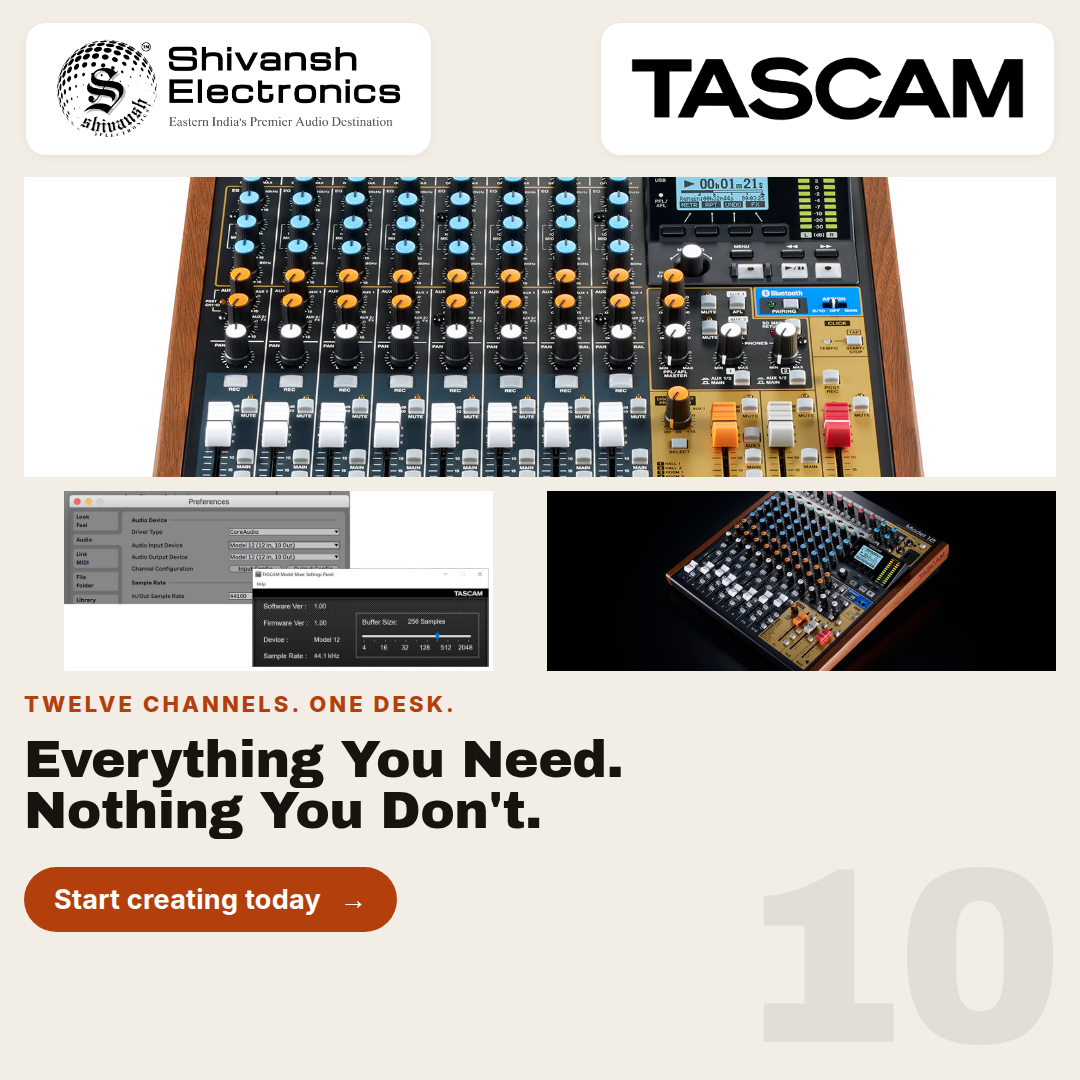
The TASCAM Model 12 is a hybrid desktop production console that combines a 10-channel analogue mixer, a 12-track internal digital multitrack recorder (MTR), and a 12-in/10-out USB audio interface into a single compact chassis. Rather than functioning as a conventional standalone mixer or a conventional standalone audio interface, the Model 12 is engineered as an integrated production ecosystem where all three roles — analogue mixing, multitrack recording to SD card, and computer connectivity — operate simultaneously and interchangeably. This makes it a genuinely flexible centrepiece for solo musicians, podcasters, streamers, and content creators who need professional-grade signal handling without assembling a rack of separate boxes.
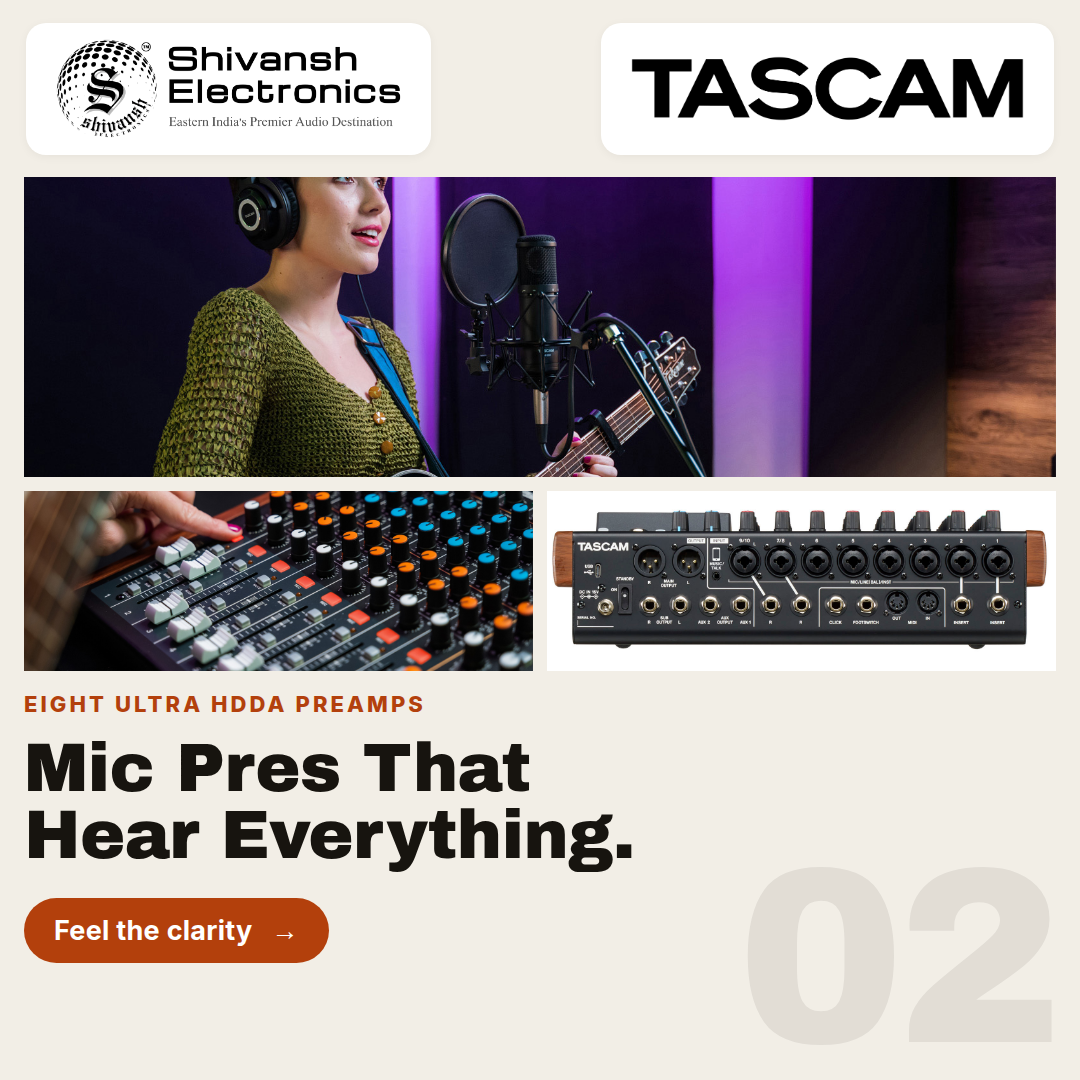
At the core of the input stage are eight XLR microphone inputs, each fitted with TASCAM's proprietary Ultra HDDA (High Definition Discrete Architecture) preamplifier design. These preamps are built around a fully discrete circuit topology rather than an integrated-chip gain stage, and they deliver up to 74 dB of gain from the MIC input to the MAIN OUT — enough headroom to bring even low-output broadcast dynamic microphones to a healthy recording level without an external inline booster. The preamps measure an Equivalent Input Noise (EIN) of -128 dBu and a Total Harmonic Distortion (THD) figure of 0.003%, placing them well within professional broadcast and studio tolerances for a console in this price and size class.
Digital conversion runs at a sampling frequency of 44.1 kHz or 48 kHz with a choice of 16-bit or 24-bit quantisation, and the internal recorder writes standard WAV files directly to SD, SDHC, or SDXC media, with no proprietary format or licensing step required to retrieve a session. Because the Model 12's digital engine handles all internal routing, processing, and recording via its own onboard DSP, small studio and podcast setups can operate the unit entirely without external analogue-to-digital converters — the console itself is the conversion stage.
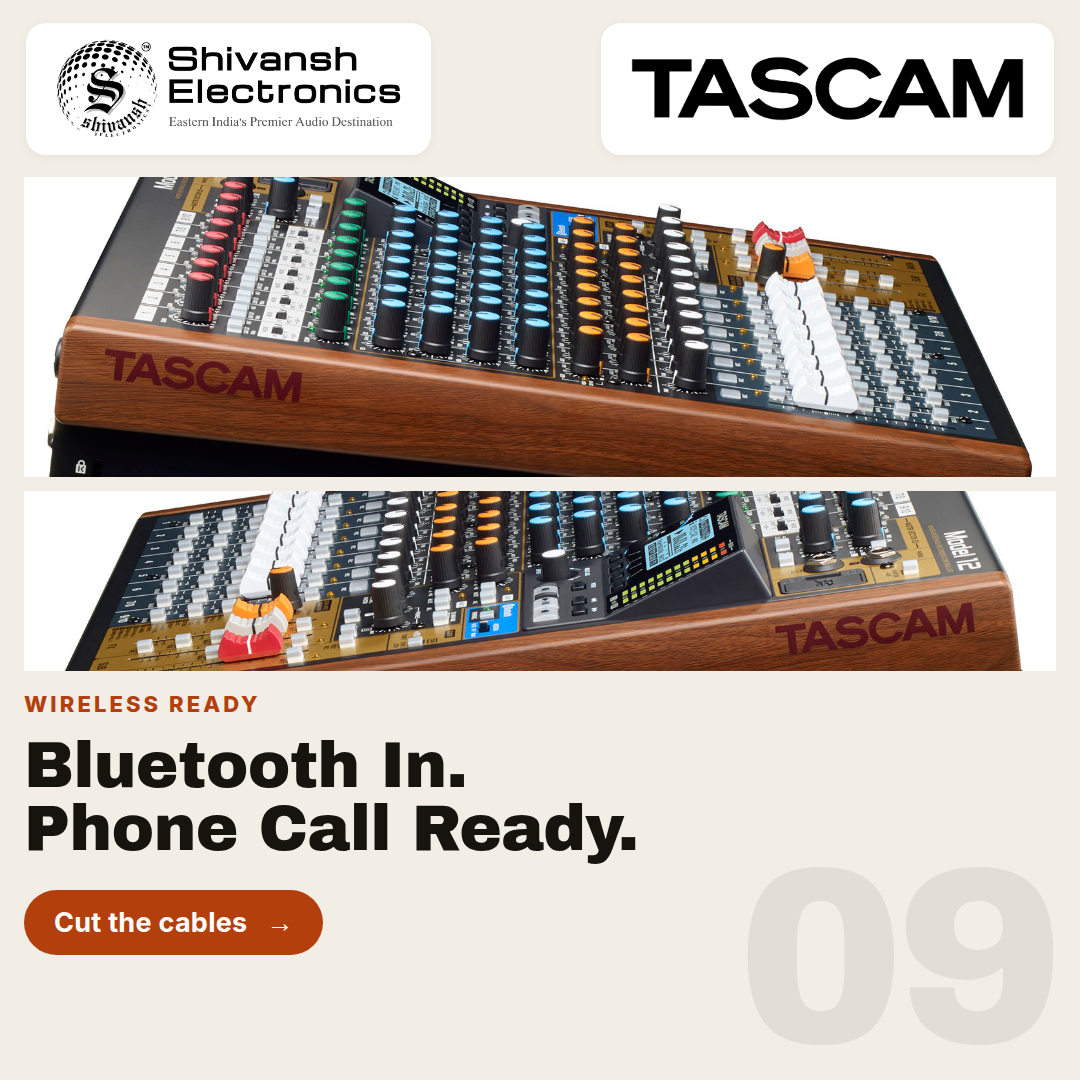
What distinguishes the Model 12 from a purely analogue mixer-recorder is its depth of modern multimedia integration. It provides native HUI/MCU protocol emulation, which converts the physical hardware faders, pan pots, and mute switches into a genuine tactile control surface for any HUI- or MCU-compatible DAW — turning a compact desktop mixer into a hands-on mixing controller for software like Pro Tools, Logic, or Ableton Live. Connectivity extends to Bluetooth 5.0 for wireless audio streaming, 5-pin MIDI In/Out ports for synchronising external hardware sequencers and synthesisers, and a dedicated 3.5mm TRRS input built specifically to bring a smartphone call into the mix with proper mix-minus routing — a feature purpose-built for remote-guest podcasting that would otherwise require a separate telephone hybrid device.
2. INPUT ARCHITECTURE & PREAMPLIFICATION
2.1 Ultra HDDA Microphone Preamps
The Model 12 provides a total of 10 analogue inputs: eight mono mic/line channels and two stereo/line channels. All eight mono channels are built around XLR connectors with TASCAM's Ultra HDDA preamp circuit and +48V phantom power switching, and each of these eight channels doubles as a Hi-Z instrument input, meaning a guitar, bass, or other high-impedance direct source can be plugged straight into any of the first eight channels without a separate DI box. Channels 1 and 2 additionally carry TRS insert points, allowing an external hardware compressor, gate, or EQ to be patched into the signal path before it reaches the internal converters — a feature not commonly found on consoles at this size and price point.
Gain staging on the Ultra HDDA circuit is engineered for headroom and clarity in equal measure: a nominal mic input level of -10 dBV combined with a 10 kΩ input impedance gives the preamps a wide, forgiving operating window suitable for both quiet condenser sources and hot dynamic microphones. Because the maximum available gain reaches 74 dB from MIC to MAIN OUT, the Model 12 is equally comfortable capturing a whispering podcast host on a low-sensitivity broadcast dynamic mic and tracking a loud brass instrument on a large-diaphragm condenser.
PREAMP AND CONVERTER SPECIFICATIONS
| SPECIFICATION | DETAILS |
|---|---|
| Maximum Gain | 74 dB (MIC to MAIN OUT) |
| Nominal Input Level | -10 dBV (Mic IN) |
| Equivalent Input Noise (EIN) | -128 dBu (Rs: 150 Ω, Max Gain) |
| Input Impedance (Mic) | 10 kΩ |
| Total Harmonic Distortion (THD) | 0.003% (MIC IN to MAIN OUT, +2 dBu, 1 kHz) |
| Signal-to-Noise Ratio | 103 dB (MAIN OUT, nominal fader position) |
| Sampling Rate | 44.1 kHz / 48 kHz |
| Bit Depth | 16-bit / 24-bit |
3. MULTIMEDIA & PODCASTING INTEGRATION
3.1 Mix-Minus TRRS Input and Bluetooth Streaming
The Model 12 sets itself apart from conventional small-format mixers with a 3.5mm TRRS input engineered specifically to integrate a smartphone into a live mix. This is not a simple auxiliary jack: the TRRS input carries hardware mix-minus routing, meaning the host's own microphone can be fed back to a remote caller while that caller's own voice is automatically subtracted from the feed sent to them, eliminating the double-talk echo that plagues any naive phone-to-mixer connection. Combined with Bluetooth 5.0 for wireless streaming of music beds, intro/outro cues, or a second wireless call source, the Model 12 is built to function as a self-contained remote-interview and podcast production hub without any additional call-handling hardware.
MULTIMEDIA AND CONNECTIVITY SPECIFICATIONS
| SPECIFICATION | DETAILS |
|---|---|
| Multimedia Inputs | Bluetooth 5.0, 3.5mm TRRS smartphone input with hardware mix-minus |
| Digital / MIDI | USB Type-C, 5-pin MIDI In/Out |
| DAW Control | HUI/MCU emulation supported |
| USB Interface | 12-in / 10-out |
4. INTERNAL RECORDING & SD MEDIA
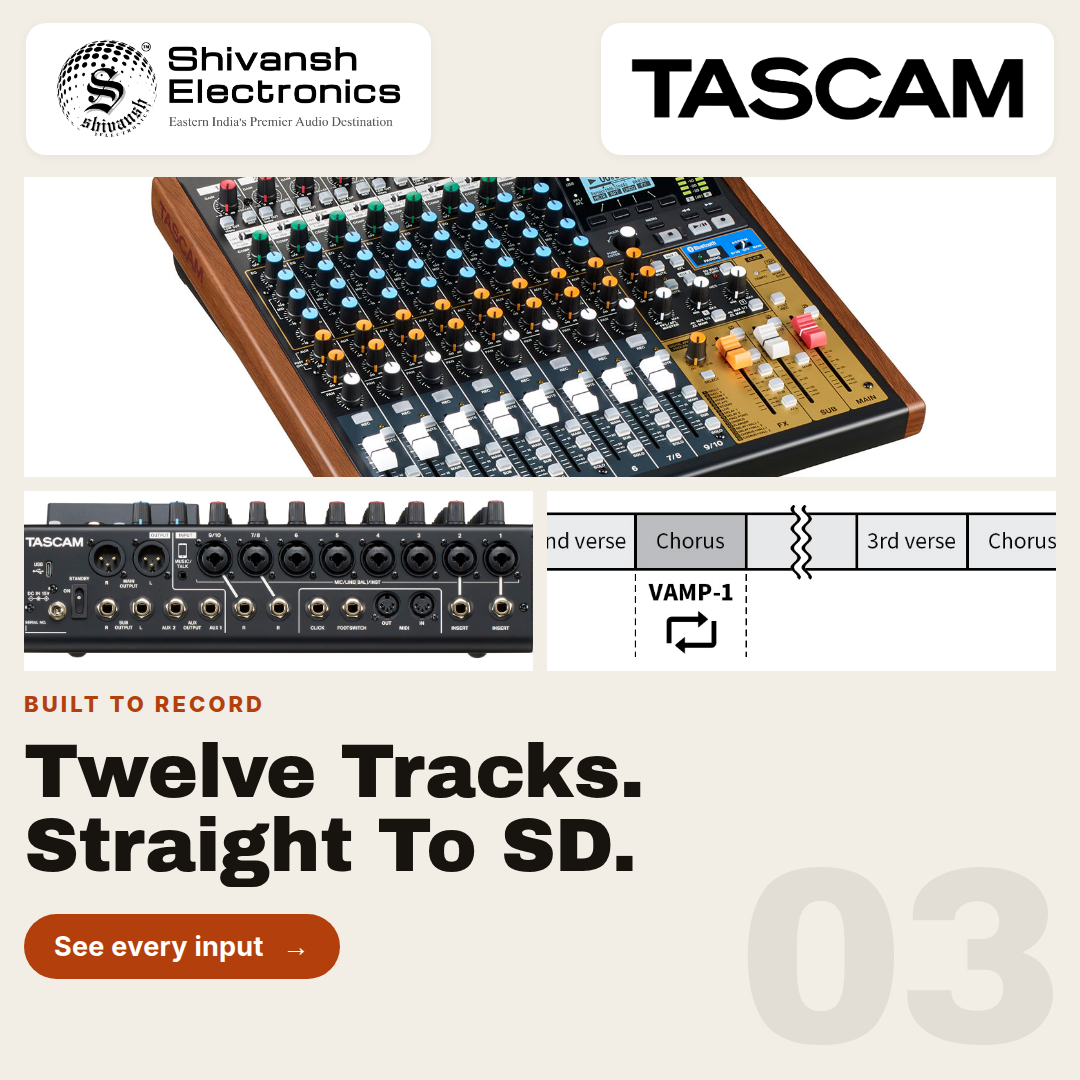
The Model 12's internal multitrack recorder captures 12 simultaneous tracks — the ten discrete analogue inputs plus the stereo main mix — directly to SD card as standard WAV files, with 10 simultaneous tracks available on playback. This DAWless recording capability means a podcast, band rehearsal, or live acoustic set can be captured as a full multitrack session with zero computer involvement, and the resulting WAV files can be pulled straight off the card and imported into any DAW later for editing or mixdown. Because the format is uncompressed standard WAV rather than a proprietary project file, there is no compatibility risk when moving a session between the Model 12 and a desktop editing environment.
RECORDING AND DIGITAL AUDIO TRANSPORT SPECIFICATIONS
| SPECIFICATION | DETAILS |
|---|---|
| Media Supported | SD Card |
| Simultaneous Record | 12 tracks (10 discrete analogue inputs + 2 stereo mix tracks) |
| Playback Tracks | 10 simultaneous tracks |
| File Format | Standard WAV |
5. PHYSICAL FORM FACTOR
| SPECIFICATION | DETAILS |
|---|---|
| Product Type | Desktop hybrid mixer / recorder / interface |
| Dimensions | 343 mm (W) × 98.8 mm (H) × 360 mm (D) |
| Weight | 4.3 kg / 9.48 lb |
6. IDEAL APPLICATIONS & USE CASES
- Podcast Production with Remote Guests: Hardware mix-minus on the TRRS smartphone input eliminates call echo without a separate telephone hybrid; 74 dB of preamp gain drives low-output broadcast mics cleanly
- Electronic Music and DAWless Sequencing: 5-pin MIDI In/Out synchronises hardware synths and drum machines to the Model 12's internal clock for fully DAWless production
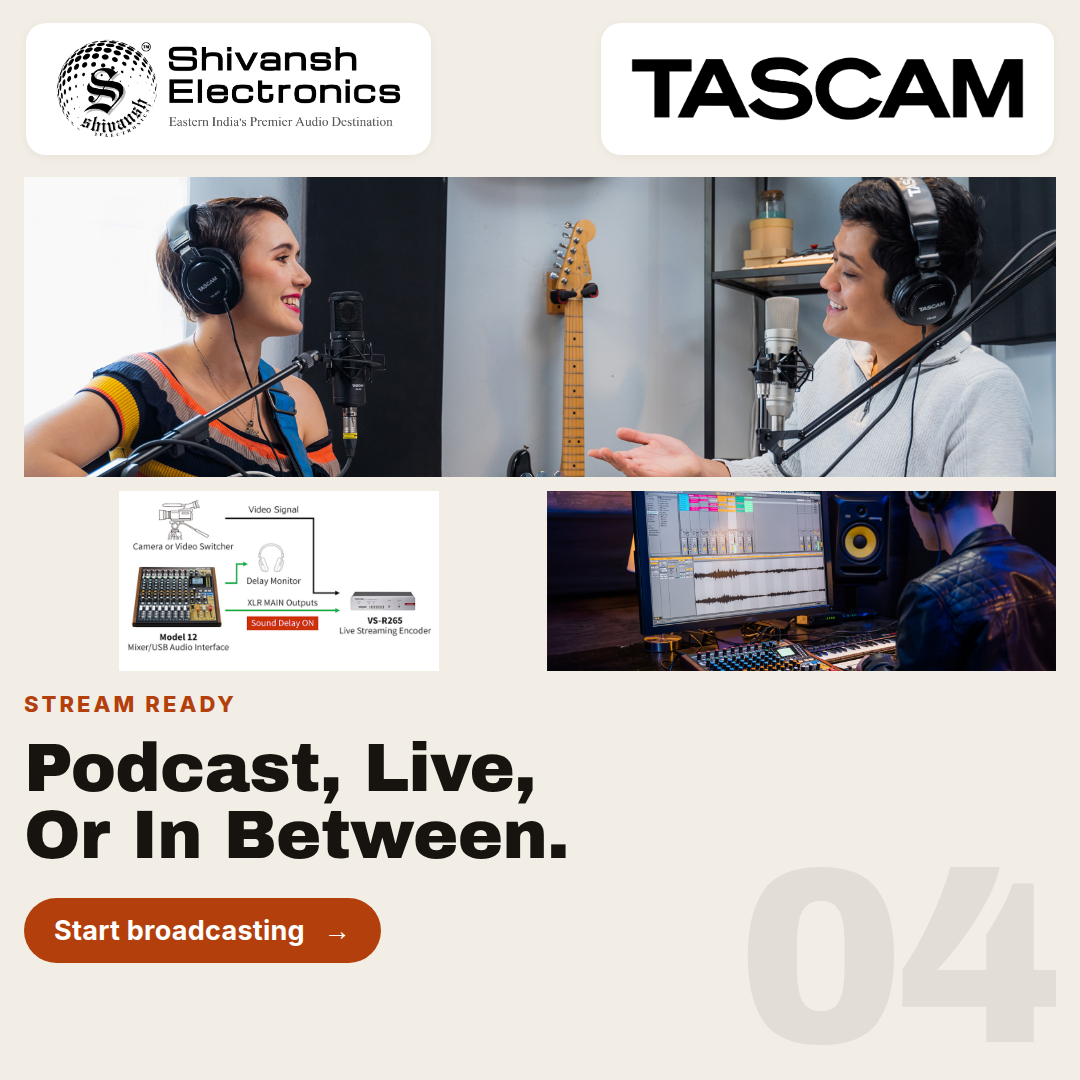
- Live Video Streaming: Adjustable output delay of up to 2,000 ms in 1 ms increments aligns audio to camera-processed video before it hits the encoder
- Small Live Acoustic Performances: Dual headphone outputs provide discrete in-ear monitoring while the internal recorder captures a 12-track multitrack archive to SD
- Audio Post-Production and Video Editing: HUI/MCU emulation turns the physical faders into a tactile jog/transport/fader controller for Premiere Pro or DaVinci Resolve
- Solo Content Creators: A single compact chassis replaces a mixer, an audio interface, and a standalone recorder for a creator working without a dedicated engineer
7. PRODUCT CONTEXT: MODEL 12 VS. SIBLING MODELS
Within TASCAM's Model series, the Model 12 occupies the compact entry point beneath the Model 16, Model 24, and flagship Model 2400. Its defining distinction from the larger models in the range is the pairing of HUI/MCU DAW control with a genuinely pocket-sized 10-channel footprint — a combination the Model 16 and Model 24 do not offer, since those two models trade DAW transport control for a wider analogue channel count and deeper mixing features instead. The Model 12 is therefore the natural choice for a buyer who values tactile DAW control and multimedia integration (Bluetooth, TRRS mix-minus, MIDI sync) in the smallest possible chassis, rather than raw input count. Engineers who need more than eight microphone preamps or a larger analogue mixing surface should look to the Model 16 or Model 24; those who specifically want DAW control in a desktop footprint will find the Model 12 the only model in the lower tier that offers it.
HOW TO READ THIS DOCUMENT
This document is the operational companion to the TASCAM Model 12 Product Description and Technical Specifications document. Where the Specs document answers the question "what does the Model 12 do and how is it measured?", this document answers the question "how do I actually use it in a real production environment?" Each workflow below describes a concrete deployment scenario with physical setup, signal routing, and an explanation of which specific Model 12 features make that workflow efficient. The routing configuration summary table at the end of each section serves as a practical checklist for any operator setting up that scenario.
Three defining workflow advantages of the Model 12 appear repeatedly across all scenarios below. First, the combination of eight Ultra HDDA mic preamps (all Hi-Z capable) with a 12-track internal SD recorder means the Model 12 can capture a full multitrack session with zero computer involvement, then hand those WAV files to a DAW afterward. Second, the hardware mix-minus TRRS input and Bluetooth 5.0 give it genuine remote-production and multimedia capability that a conventional small mixer does not offer. Third, HUI/MCU emulation means the same physical unit that tracks a session can also become a tactile control surface for mixing or editing that session later — the Model 12 does not become redundant once tracking is finished.
WORKFLOW 1 — PODCAST PRODUCTION WITH REMOTE GUESTS
Scenario: Two-Host Studio Bringing In a Remote Caller via Smartphone
In a dedicated podcast studio, the Model 12 serves as the central production hub. The host connects a low-output broadcast dynamic microphone to Channel 1, using the Ultra HDDA preamp's 74 dB of maximum gain to achieve a healthy recording level without needing an inline gain booster — a common workaround required by cheaper preamp designs when paired with broadcast-style dynamic mics. A co-host is patched into Channel 2 on an identical microphone and gain setting. A remote guest is brought into the session via a smartphone connected to the 3.5mm TRRS input.
The feature doing the real work in this deployment is the hardware mix-minus routing applied to the TRRS input: it feeds the hosts' microphones back to the caller while simultaneously subtracting the caller's own voice from that return feed, which prevents the debilitating echo/double-talk problem that occurs whenever a phone call is connected to a mixer without mix-minus handling. The full session — both hosts and the remote caller — is captured simultaneously to the internal SD card as a 12-track multitrack backup, and the stereo mix is transmitted over USB-C to a recording or streaming computer at the same time, giving the show both a safety multitrack and a live mix in a single pass.
Routing and Configuration Summary
| WORKFLOW ELEMENT | DETAILS / CONFIGURATION |
|---|---|
| Host Microphones | Channels 1–2, broadcast dynamic mics, Ultra HDDA gain set for -10 dBV nominal input |
| Remote Guest | Smartphone → 3.5mm TRRS input, hardware mix-minus engaged |
| Recording Path | Simultaneous 12-track capture to internal SD card (10 inputs + stereo mix) |
| Streaming/Computer Path | Stereo mix out over USB-C (12-in/10-out interface) to streaming or DAW software |
| File Format | Standard WAV, 24-bit/48 kHz for post-production flexibility |
| Gain Structure | Up to 74 dB available per mic channel; typically 45–55 dB for broadcast dynamics |
WORKFLOW 2 — ELECTRONIC MUSIC DAWLESS SEQUENCING
Scenario: Hardware Synth Rig Tracked Live, Then Mixed in the DAW via HUI/MCU
An electronic music producer requires a central clocking and mixing hub for a rack of hardware synthesizers and drum machines. Drum machines and synths are connected across the mono and stereo line inputs of the Model 12. The load-bearing functionality here is the 5-pin MIDI In/Out ports, which synchronise the tempo of the external sequencers with the Model 12's internal clock — meaning every piece of outboard gear locks to a single, reliable timing reference without a separate MIDI interface or clock generator.
The producer tracks a full live performance directly to the SD card as a multitrack session. Later, back at a desktop DAW, the producer engages HUI/MCU emulation and uses the Model 12's physical faders and transport controls to mix the printed stems inside Ableton Live or a similar HUI/MCU-compatible DAW — bridging the gap between hardware tracking and a tactile digital mixing pass without buying a separate control surface.
Routing and Configuration Summary
| WORKFLOW ELEMENT | DETAILS / CONFIGURATION |
|---|---|
| Hardware Sources | Synths/drum machines on mono and stereo line inputs |
| Clock Sync | 5-pin MIDI Out → external sequencers, Model 12 as master clock |
| Live Tracking | Full performance recorded to SD card as a multitrack session |
| DAW Mixdown Stage | HUI/MCU emulation engaged; physical faders control printed stems in-DAW |
| Sample Rate | 48 kHz / 24-bit for tracking |
WORKFLOW 3 — LIVE VIDEO STREAMING SYNC
Scenario: Aligning Audio to a Delayed Camera Feed in OBS
A live streamer routes multiple microphones and a Bluetooth audio feed into the Model 12, sending the resulting stereo mix to OBS via the USB Type-C connection. Because the video feed from the streaming camera requires processing time on its way through the capture chain, the video inherently lags behind the audio arriving directly over USB. The operator relies on the Model 12's adjustable output delay function — tunable up to 2,000 ms in 1 ms increments — to precisely align the audio stream with the video frames before the signal reaches the encoder, avoiding the lip-sync drift that would otherwise require a separate delay plug-in inside OBS.
Routing and Configuration Summary
| WORKFLOW ELEMENT | DETAILS / CONFIGURATION |
|---|---|
| Microphone Inputs | Multiple presenter/guest mics on XLR channels |
| Wireless Audio Feed | Bluetooth 5.0 for music beds / secondary audio source |
| Computer Output | Stereo mix → USB-C → OBS Studio |
| Sync Correction | Output delay set 0–2,000 ms in 1 ms steps to match camera processing lag |
WORKFLOW 4 — SMALL LIVE ACOUSTIC PERFORMANCE
Scenario: Coffee Shop FOH with In-Ear Monitoring and Multitrack Archive
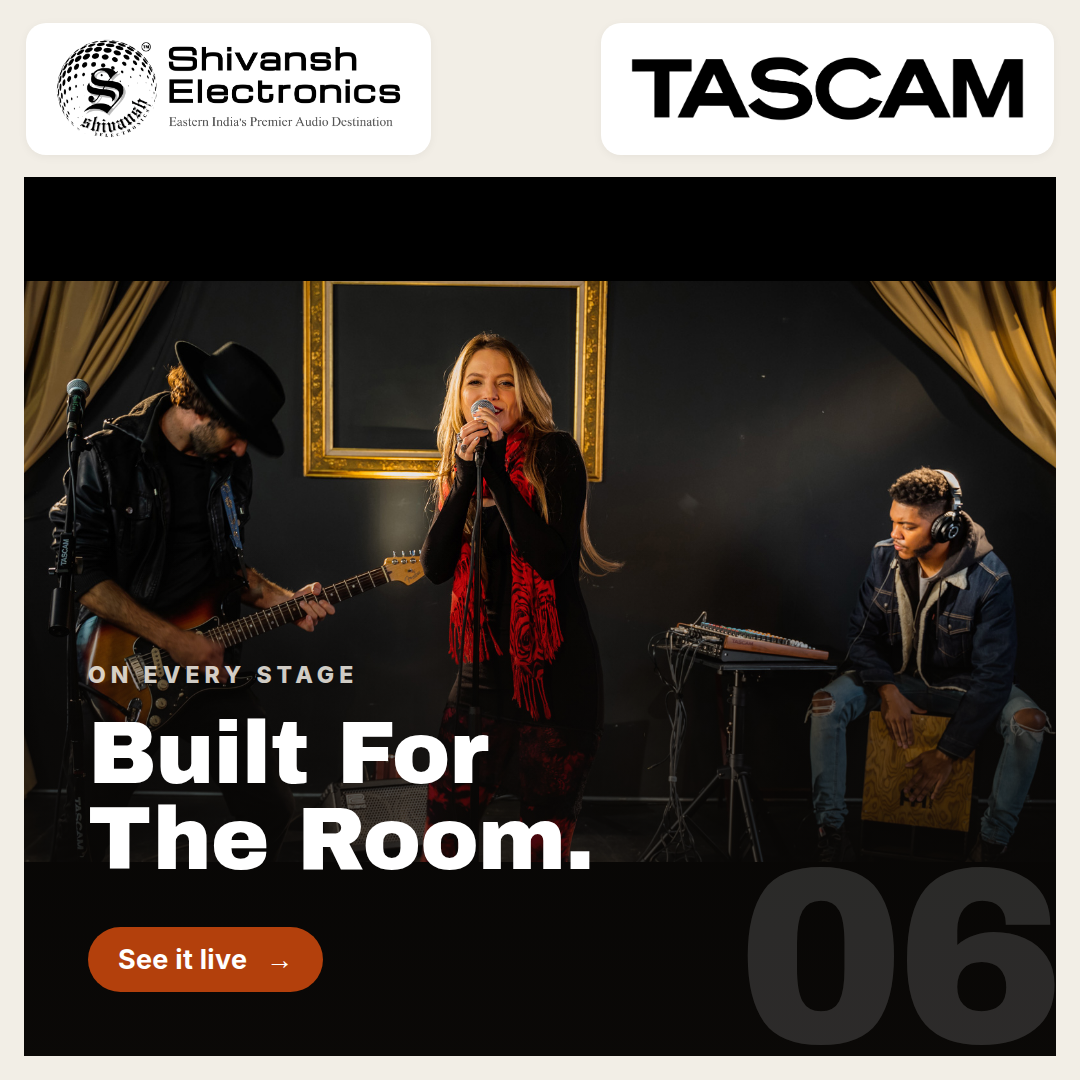
A coffee shop hosts a live acoustic trio and uses the Model 12 as its Front-of-House (FOH) console. The sound engineer uses the dual headphone outputs to provide two discrete in-ear monitor feeds for the musicians — for example, a vocalist's mix leaning on their own voice and a guitarist's mix leaning on the rhythm section. During the performance, the engineer arms the internal multitrack recorder, capturing all 12 tracks (10 inputs plus the stereo mix) at 24-bit/48 kHz to an SD card for a future promotional release, without any laptop present at the venue.
Routing and Configuration Summary
| WORKFLOW ELEMENT | DETAILS / CONFIGURATION |
|---|---|
| FOH Role | Model 12 as standalone FOH console, no computer required |
| Monitor Mixes | Two independent in-ear feeds via dual headphone outputs |
| Multitrack Capture | 12 tracks (10 inputs + stereo mix) to SD card, 24-bit/48 kHz |
| Use of Archive | WAV files pulled from SD card for later promotional mixdown |
WORKFLOW 5 — AUDIO POST-PRODUCTION EDITING
Scenario: Tactile Control Surface for Premiere Pro or DaVinci Resolve
A video editor uses the Model 12 strictly as a tactile control surface and monitoring controller rather than for tracking. Connected via USB Type-C to an editing workstation running Adobe Premiere Pro or DaVinci Resolve, the editor engages MCU protocol emulation to jog the timeline, arm tracks, and ride faders dynamically during a mixdown pass — all from the physical console rather than a mouse. The balanced XLR main outputs feed a clean, 103 dB signal-to-noise feed to the studio monitors for accurate critical listening while the mix is being built.
Routing and Configuration Summary
| WORKFLOW ELEMENT | DETAILS / CONFIGURATION |
|---|---|
| Host Connection | USB Type-C to editing workstation |
| Control Mode | MCU protocol emulation for jog/transport/fader control |
| Monitor Output | Balanced XLR MAIN OUT → studio monitors, 103 dB S/N |
| Software Compatibility | Any HUI/MCU-compatible NLE or DAW |
WORKFLOW 6 — SOLO SONGWRITER DEMO TRACKING
Scenario: Guitar/Vocal Overdubbing with Outboard Compression on the Insert
A solo songwriter uses the Model 12 as a bedroom-studio tracking hub. A large-diaphragm condenser is connected to Channel 1 for lead vocal, with a hardware compressor patched into the Channel 1 TRS insert point to shape the vocal dynamics before it reaches the internal converter — useful for a songwriter who wants a controlled level going to tape without relying entirely on software compression afterward. An acoustic guitar is plugged directly into the Hi-Z instrument input on Channel 2, avoiding the need for a separate DI box. Both channels are recorded to the internal SD card while simultaneously streaming to a laptop DAW over USB-C, giving the songwriter a hardware safety copy of every take alongside the DAW session.
Routing and Configuration Summary
| WORKFLOW ELEMENT | DETAILS / CONFIGURATION |
|---|---|
| Vocal Channel | Channel 1, condenser mic, hardware compressor via TRS insert |
| Guitar Channel | Channel 2, Hi-Z direct instrument input, no DI box required |
| Dual Capture Path | Simultaneous SD card recording + USB-C streaming to laptop DAW |
| Phantom Power | +48V enabled on Channel 1 for the condenser mic |
WORKFLOW 7 — BAND REHEARSAL SPACE MULTITRACK CAPTURE
Scenario: Four-Piece Band Recording Rehearsals Without a Resident Engineer
A rehearsal space equips itself with the Model 12 so a band can self-record without a dedicated audio engineer present. Vocals, guitar amp, bass DI, and a stereo drum overhead pair fill the eight mono/Hi-Z channels between them, with the stereo channels handling an additional room mic pair. Because the eight mono channels are all Hi-Z capable, the bass can be plugged in directly rather than mic'd, freeing up a microphone and stand. The band presses record on the internal recorder before each run-through, capturing every rehearsal as a 12-track SD session that can be reviewed on headphones immediately afterward or exported to a DAW for a rough mix later.
Routing and Configuration Summary
| WORKFLOW ELEMENT | DETAILS / CONFIGURATION |
|---|---|
| Instrument Sources | Vocal mic, guitar amp mic, bass DI (Hi-Z), stereo drum overheads |
| Bass DI Routing | Direct into Hi-Z instrument input, no external DI box |
| Recording Trigger | Manual record-arm before each rehearsal run-through |
| Immediate Review | Headphone playback on-site directly from the Model 12 |
WORKFLOW 8 — HOUSE OF WORSHIP SUNDAY SERVICE
Scenario: Volunteer Operator Running Live Sound, Recording, and a Bluetooth Walk-In Playlist
A small church uses the Model 12 to run its Sunday service audio with a volunteer operator rather than a professional engineer. Pastor and worship-team microphones occupy the XLR channels, while pre-service walk-in music and any pre-recorded video-slide audio are streamed in via Bluetooth 5.0, avoiding the need for a separate playback device patched into a spare channel. The volunteer relies on the HUI/MCU-informed physical layout being simple and consistent week to week, and every service is captured to the internal SD card as a full multitrack session, giving the media team raw stems to build a podcast or online-service upload from afterward.
Routing and Configuration Summary
| WORKFLOW ELEMENT | DETAILS / CONFIGURATION |
|---|---|
| Live Mics | Pastor and worship-team mics on XLR channels |
| Walk-In Music | Bluetooth 5.0 streaming from a phone or tablet |
| Weekly Archive | Full service recorded as a 12-track SD session |
| Post-Service Use | Raw stems handed to media team for podcast/online upload |
WORKFLOW 9 — MULTI-GUEST TALK SHOW / INTERVIEW FORMAT
Scenario: Three In-Room Guests Plus One Remote Caller
A YouTube interview show regularly seats a host and up to three in-room guests around a table, filling four of the eight mono mic channels, while a recurring remote contributor phones in via the TRRS mix-minus input. Because each of the eight channels carries its own Ultra HDDA preamp, every guest gets independently calibrated gain regardless of how quietly or loudly they speak, rather than sharing a single compromise gain setting across a sub-mixed group. The show captures all five sources — four in-room mics plus the remote caller — as a 12-track session to SD card, giving the editor complete isolation to remove crosstalk, re-balance any one guest's level, or cut a guest's line entirely during post without affecting the others.
Routing and Configuration Summary
| WORKFLOW ELEMENT | DETAILS / CONFIGURATION |
|---|---|
| In-Room Guests | Host + 3 guests on 4 independent XLR channels |
| Remote Contributor | TRRS input with hardware mix-minus |
| Isolation Benefit | Independent Ultra HDDA gain per channel; full multitrack isolation on SD |
| Editorial Flexibility | Post-production isolation for level correction or removing a guest's line |
WORKFLOW 10 — VOICEOVER AND AUDIOBOOK NARRATION BOOTH
Scenario: Long-Form Single-Narrator Recording with Outboard De-Essing
A voiceover artist uses the Model 12 in a treated booth for long-form audiobook narration. A single condenser microphone is connected to Channel 1, with a hardware de-esser patched into the TRS insert point to tame sibilance in real time before the signal is converted, reducing the amount of corrective editing required afterward. Sessions are recorded directly to the SD card in long unbroken takes at 24-bit resolution, and because the recorder writes standard WAV rather than a proprietary format, chapters can be split and delivered to a publisher or platform without any conversion step. Between takes, the narrator can plug a phone into the TRRS input to receive director notes from a remote producer without ever leaving the booth.
Routing and Configuration Summary
| WORKFLOW ELEMENT | DETAILS / CONFIGURATION |
|---|---|
| Narration Mic | Channel 1, condenser mic, +48V phantom power |
| Insert Processing | Hardware de-esser via Channel 1 TRS insert |
| Recording Format | Standard WAV, 24-bit, to SD card |
| Director Communication | TRRS phone connection for remote director notes between takes |
FEATURE-TO-WORKFLOW CROSS-REFERENCE MATRIX
The following table maps every major feature of the TASCAM Model 12 to the workflow categories where that feature provides the most direct operational advantage. Anyone evaluating the Model 12 for a specific deployment scenario can use this table as a quick reference to confirm the unit's capabilities match their requirements.
| FEATURE | RELEVANT WORKFLOWS |
|---|---|
| Eight Ultra HDDA mic preamps, 74 dB max gain | Wf1 (Podcast), Wf6 (Songwriter), Wf7 (Band), Wf8 (House of Worship), Wf9 (Talk Show), Wf10 (Voiceover) |
| TRRS mix-minus smartphone input | Wf1 (Podcast), Wf9 (Talk Show), Wf10 (Voiceover — director notes) |
| Bluetooth 5.0 streaming | Wf3 (Streaming), Wf8 (House of Worship — walk-in music) |
| 5-pin MIDI In/Out | Wf2 (DAWless Sequencing — exclusively) |
| Adjustable output delay (0–2,000 ms) | Wf3 (Live Streaming Sync — exclusively) |
| Channel 1–2 TRS insert points | Wf6 (Songwriter — compression), Wf10 (Voiceover — de-essing) |
| Hi-Z instrument inputs (Channels 1–8) | Wf6 (Songwriter — guitar), Wf7 (Band — bass DI) |
| HUI/MCU DAW emulation | Wf2 (DAWless Sequencing — mixdown), Wf5 (Post-Production) |
| Dual headphone outputs | Wf4 (Live Acoustic Performance — exclusively) |
| 12-track internal SD recorder | All workflows; foundational to every scenario above |
| 103 dB S/N balanced XLR main outputs | Wf5 (Post-Production — critical monitoring) |